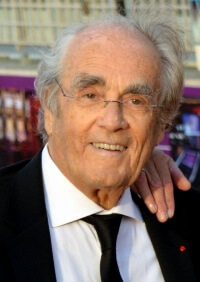
The French composer and three-time Oscar winner Michel Legrand is dead. As several French media reported, referring to his press spokesman, Legrand, famous for his film music, died in Paris on Saturday night at the age of 86.
Legrand’s first musical impressions came from his father Raymond Legrand, who, as director of a variety orchestra, accompanied musicians such as Édith Piaf and Maurice Chevalier. He completed his studies at the Paris Conservatoire in 1952 with Nadia Boulanger, among others. Already in that year he arranged a string album for Dizzy Gillespie. In 1952 he accompanied Maurice Chevalier on a tour of the USA.
Since the end of the 1950s he turned increasingly to film music. His soundtracks for Hollywood movies founded his world fame. One of his world-famous works is the musical drama Les Parapluies de Cherbourg from 1964, in which Catherine Deneuve made her first appearance. He was nominated twelve times for the Oscar, which he couldn’t believe for the film song to Thomas Crown, Windmills of your Mind (1968) and the soundtracks to the films Summer of 42 (1971) and Yentl (1983). In addition, he was nominated three times for the César and twelve times for the Golden Globe Award, which he once received for The Thomas Crown Affair.
France’s Minister of Culture Franck Riester praised Legrand on Saturday as a “brilliant composer”. The singer Mireille Mathieu remembered her collaboration with the musician who had written several songs for her. Legrand’s musical ideas “enchanted the whole world,” said the 72-year-old. “For me, he is immortal because of his music and personality,” said composer Vladimir Cosma on the death of his colleague.
How was it with you? Found a lot of new stuff under the Christmas tree? In any case, our editors found a large number of new note tunes for all genres of music. We have opened these packages and listed the most important things for you. You will find a lot of interesting information under the following links:
17 Queen-Songs in a single book
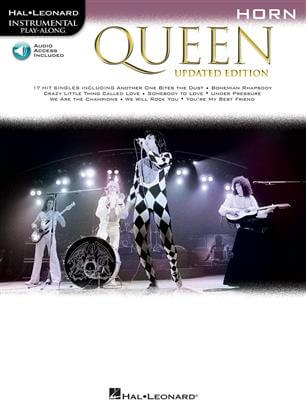
Queen and wedding music for various wind instruments, music for guitar and piano, these are the highlights of the sector “music for solo instrument”. The booklets “Queen” for example contain solo arrangements of 17 Queen songs for various instruments with accompanying tracks: Another One Bites the Dust – Bohemian Rhapsody – Crazy Little Thing Called Love – Fat Bottomed Girls – Killer Queen – Radio Ga Ga – Somebody to Love – Under Pressure – We Are the Champions – We Will Rock You – You’re My Best Friend – and more.
60 Years Musical Hair
About 60 years ago the musical “Hair” was released, which has been performed successfully all over the world since then. For choirs we have recorded the current editions. Acu other works by Franz Xaver Engelhart, Howard Hanson, Justin Paul and others can be found here.
Double release: for 4 Alphorns
More than 140 works have been published for various ensembles. Among them single titles like “Hallelujah” by Leonard Cohen for all possible wind ensembles. But also collections like “Disney Songs” by Hal Leonard or “Lumbejack-Polka” for 4 Alphorns. Ravel, Mancini, Rossini, Morricone are further names whose works have been arranged for various ensembles.
“Walk The Moon” are back with “One Foot”!
Filmmusik and Lieder aus der Popular Musik have appeared for string orchestras and similar orchestras. For example “One Foot” is a song by the American rock band “Walk the Moon” for their third studio album, What If Nothing (2017). The song was released on September 22, 2017 as the album’s lead single. Billboard said the song “promotes the same ecstatic abandonment as Shut Up and Dance,” but unlike its predecessor, the 90’s revered predecessor, it follows EDM logic with a gravity-repellent beat drop and echoing vocals. Eli Maiman said, “It’s an indication of the larger, epic sound of the album.” Nicholas Petricca said, “‘One foot’ faces emptiness. On the last record we had the feeling that we had many answers. This time we have a lot of questions.
Letters Polka by Josef Strauß
Finally, more than 140 works for wind orchestra have been newly recorded and linked to numerous background information. From folk music to Schlager, film to opera and many works by contemporary composers can be found. For example, the “letter polka”: together with other novelties, this polka française was first heard on 24 July 1868 at a concert that took place during the Bundes-Schützenfest in Vienna’s Volksgarten. The original work gained its name from the fact that Josef Strauss had the main motif begin with an ascending scale in F major, which comprises the first seven letters of the alphabet: a-b-c-d-e-f-g.
When downloading you were in prison with one foot for a long time.
Music download was at the beginning of the Internet until well beyond the first decade of this century often a criminal activity. Various copyright regulations have now legalized these possibilities and many publishers and music producers now offer this form of legal trade themselves. For some months now you have been able to find a link to these legal sites on certain works, where you can – for a fee – buy the whole work or parts of it and print it yourself. Some publishers have price differences between print and download editions, others have the same price. We have no influence on this. But the advantage is that with many downloads you can also buy individual voices. This is practical and works fast and unproblematic.
Over 2400 wind orchestra works are already included in the download list. In addition to these complete editions, additional scores and individual voices are also available for direct printing. Choral music has more than 1,400 titles, although publishers often offer a minimum quantity. In the field of ensemble literature there are currently more than 2,700 works on the list and in the complex of solo literature there are even more than 8,000 titles.
By the way, there are also over 1,200 CDs in our database, which you can buy and download either completely or individually. This is a service that you won’t find so quickly on other databases.
Unfortunately, there are also some limitations: Contracts between international publishers prohibit downloads of some works in certain countries. There will be a message that the download is “unfortunately forbidden in your country”. Sorry, we have no influence on that and in this case there is only the usual way of postal order.
If you want to search for specific issues with download, use the filter “External Download-Link” in the search mask. This logo External download link also indicates where downloads are available.
Bert Appermont gives his name to the current CD of the Swiss National Youth Wind Orchestra
{Battleof hearts – two ladies fight for the heart of a count.}
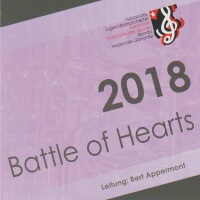
“Battle for Hearts” is a composition by Bert Appermont. In this work is a source of inspiration Heinrich von Kleist’s theater piece “Das Käthchen von Heilbronn”, written in 1810. The music recalls the underlying drama, tensions and emotions of the characters involved: “The Blacksmith’s Daughter”, “Kunigunde”, “The Fire” and “The Emperor’s Daughter”. The title Battle of Hearts refers to the two ladies of the story (Käthchen and Kunigunde), who both fight for the heart of the “Count of Strahl”. It is an impressive, not programmatic, but very thematically influenced work that is suitable for concerts and competitions. This composition gives its name to the current CD of the Swiss National Youth Wind Orchestra.
The orchestra consists of around seventy highly motivated young musicians, a competent conductor and a professional team of register teachers. These guarantee the achievement of the musical goals. The orchestra organises itself in the course of an annual training week and performs as a sympathetic calling card for Swiss youth music with high-quality concerts and selected music programmes.
The musical director of this CD is Bert Appermont, who has recorded further compositions by Ottorino Respighi (Pini die Roma), Mario Bürki (1405: Der Brand von Bern), Etienne Crausaz (Balkan Dance), George Gershwin (An American in Paris) and JohnPhilip Sousa.
Grace for all Nation: a Reformation Document for Spiritual Music
{Reformation 500: Grace for all Nations}
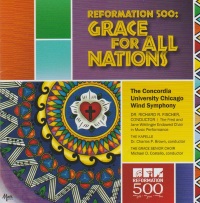
Contemporary compositions of sacred music alternate with arrangements of Christian hymns by Martin Luther. Conductor Richard R. Fischer of the “Concordia University Chicago Wind Symphony“, together with “The Grace Senior Choir” (conductor: Michael D. Costello) writes in this CD “Grace for all Nations“:
“This recording project is exciting and worthwhile, allowing members of the Wind Symphony to provice members of the church, as well as elementary, secondary and college band conductors with outstanding perfomances of much previously unrecordec sacred works for winds. For band conductors and their students throughout the world, it provides a model for the performance of these works. For members of the church, it provides an ongoing music ministry of sacred works that are frequently inspired by familiar hymn tunes.
There is a great need in our chirch for live performances that include the playing of sacred music. While the greatest benefir is derived by being in attendance at a concert or worship service, a recording project such as this allows us not only to share our musical gifts with others, but also to provide the listener with an opportunity to experience over and over again the uplifting sounds of wind and percussion the boldly give glory and praise to our God.“
Compositions by Jay Bocook, Johann de Meij, Eric Whitacre, John Zdechlik, Stephen M. Lounsbrough, Christopher Nelson and William R. Brusick have contributed to this CD. Worth listening to and interesting.
The European competition leaves its mark on concert programmes.
{European Song Contest)
The “European Song Contest” has already been going on for over 60 years. You can stand by it as you like, but this series has produced some beautiful and lasting songs. So it’s no wonder that some orchestra conductors want to draw from this pot of evergreens and put them into a program. A few days ago this letter reached us:
“…I need your help. I’m planning a concert next year with songs that were part of the Eurovision Song Contest. It doesn’t have to be just winning titles. Please have a look at your great database. Thank you very much and best wishes for the New Year”! (E.B.)
Such requests are a welcome task for us. To test our database or possibly to upgrade to these questions. In this case we have completed the data and you can find these works as follows:
Category: Wind Orchestra/HaFaBra Instrumentation: Wind orchestra (Ha)
in the Full text search line: EuropeanSongContest (preferably without space between words)
Start search
Now, of course, there’s no point in just citing the part. You should also receive the corresponding background information. And we have supplemented these extensively and as optimally as possible. This is the only way to turn an information database into an informative database.
If you have unusual search queries, do not hesitate to contact us. We will help you as quickly and comprehensively as possible.
More than 30 youth wind orchestras from Austria and the partner associations South Tyrol and Liechtenstein qualified for the 8th Austrian Youth Wind Orchestra Competition. From very light to difficult literature, more than 1000 young musicians performed in the large hall of the Brucknerhaus in Linz on 29 October 2017. The versatility of the youth works and especially the different interpretations of the compulsory pieces represented a musically exciting competition for the audience.
International Youth Wind Orchestra Competition 2017
The Austrian Wind Youth of the ÖBV has collected the best of these youth orchestras on 4 CDs in two double albums. Although the two albums are not the most recent edition, we believe that this valuable information is interesting not only for youth orchestras but also for orchestras of lower to medium levels.
The CDs can be ordered directly from:
Austrian youth wind band association
Hauptplatz 10
9800 Spittal/Drau
If the CDs are out of stock, you can request individual tracks from us free of charge.
A ballet in three acts with 50 minutes playing time
“The Garden of Earthly Delights”, Troptychon of Hieronimus Bosch
Hieronimus Bosch’s mysterious images pose great puzzles to experts. They are ambiguous to interpret. In particular, the triptych picture “The Garden of Earthly Desires,” which depicts scenes that seem almost prophetic from the creation of the world to the apocalyptic end, is often the focus of expert criticism.
With a total duration of about 50 minutes, the American composer Leroy Osmon has created a musical work as monumental as this picture “The Garden of Earthly Desires“. The ballet consists of an “introduction”, three “acts” (each with four “scenes”) and an “interlude” before “Act III”. The titles for each act and scene come directly from certain sections of the Bosch painting. The inspiration for each section came from the painting as a whole and from the smallest images within the painting. The different styles of music are directly related to the images on the canvas: from the brutal to the sublime, from the abstract to the realistic. The ballet, like the painting, is a triptych (the three Acts of the Apostles) and the introduction (the third day of creation) is the upper panel of the painting. The music is a graphic representation of the Bosch painting and follows the same biblical narrative.
Composer Leroy Osmon
The composer Leroy Osmon lived and worked for several years in the Mexican state of Veracruz and was a personal friend of several members of the “Banda Sinfonice Del Gobierno Del Estado”. He composed many of the solo passages with a view to his friends. The role of the bass trombonist embodied the devil from Bosch’s vision of evil.
Act I represents the left panel and depicts Adam and Eve, the snake, various predators and the downfall of Eden.
Act II presents Noah (represented by the continuous playing of a two-part motif), lust, eroticism and the vulnerability of innocence, complete with a cast of naked figures and fantastic animals.
Act III, the right panel, has been described by art theorists as a “landscape of hell and portrays the tortoises of damnation” through a dance of perverted love and lust, death and vanity, ending with a hallucinating nightmare. Although historians and critics may have interpreted the painting as a didactic warning of the dangers of life’s damnation, the composer Leroy Osmon regarded it as a representation of a true degree of earthly joy; an erotic garden that the American writer Peter S. Beagle described as “a place of intoxication and complete freedom.
Osmond’s ballet presents a musical panorama of this lost paradise. Several of the composer’s works are represented in these compositions. When the composer received the commission for this ballet, Osmon worked on an homage to Ravel and the revisions of an early piano concerto. It was decided to include both works in the ballet with new material. There are three direct references to Ravel (the composer whom Osmon calls “the definition of my harmonic world”), as well as two complete movements of the Piano Concerto that went into the ballet. There are brief moments from other composers – including Ives, Grainger, Alwyn, Lloyd and Revueltas – who have inspired and guided Leroy Osmon harmonically and rhythmically for more than 50 years.
New catalogue with new releases 2018-2019 published by Hal Leonard Europe.
Neuerscheinungen & Highlights 2018-2019
Hal Leonard is probably the biggest European publisher. Together with its headquarters in America, the European branch presents the catalogue New Publications and Highlights 2018-2019 with music for wind orchestra, brass bands, jazz ensemble and school orchestra. The publishers Hal Leonard (us), De Haske (nl), Anglo Music (uk), Beriato (be), Amstel Music (nl), Fentone Music (uk), IberMusica (es), Scherzando and Mitropa (ch), Gobelinmusic (nl) and Harper Music Publications (uk) are represented. Although Austria and Germany are not directly represented in the publishers, there is a lot of music from these countries with works by Thomas Doss, Otto M. Schwarz, Gerald Oswald, Stefan Schwalgin, just to name a few. Japan is also present with strong works by Sathoshi Yagisawa, Hideaki Mura and Eiji Suzuki.
Themaitsch beautifully structured you will find opening music, solo works, concert pieces, pop music, film music and many other themes. We have added additional valuable information and links, numerous complete recordings, videos and scores complete the information value in our database.
Generation change in the board of the Music Information Association
In June 2018 the youngest general assembly of our organization “Music Information Association” took place. In this connection a generation change was decided at the association. In order to guarantee a smooth transition, a one-year transition phase is agreed for 2019. During this time both the technical and the organizational work will be accompanied by the old board and the work of the new management will be supported.
Doris Stadlmann was elected as the new President, replacing Helmut Schwaiger, who has been President for many years. However, he will continue to be in charge of the musical aspects of the database. Rudolf Josef Hödl was appointed as deputy, replacing Michael Hug. Michael Hug von Ruh Musik AG will continue to be the delivery partner for Switzerland.
Sigrid Stadler is the new secretary and her deputy will continue to be Juliane Pierer-Kliment. Also Johanna Heissl was confirmed as responsible for the finances of the association, her deputy is Günther Stadler. Harald Loidl of the tax office WTH-Seekirchen continues to act as the 1st auditor and Rudolf Schwaiger was appointed as the 2nd auditor.
Robbin D. Knapp as Webmaster and technical director of the data base will go in the next months into pension. His agenda will be taken over by a new partner, whom we will introduce in our next newsletter.