Celebration of the Most Holy Body and Blood of Christ
Lake procession Traunkirchen (Old postcard)
In the liturgy the feast is called “High Feast of the Body and Blood of Christ”, regionally it is also called Prangertag or Blood Day. In English and other languages the Latin name of the Hochfest, Corpus Christi, is used.
The Corpus Christi procession takes place every year on the Thursday following Trinity Sunday. The Feast of Corpus Christi originated in Liège in 1246. In Vienna, Corpus Christi processions can be traced back to at least 1334. The Corpus Christi procession was a central point in the religious life of the city’s population.
A special form of Corpus Christi procession has developed in the Salzkammergut: “lake processions” take place in Traunkirchen and Hallstatt (Upper Austria). One reason for this form of procession, apart from the spatial problem, was especially the religious aspect, since the Eucharistic secret had to be brought into the consciousness of the participants in a psychologically impressive and pedagogically effective way.
In Austria, Bavaria and other Catholic countries a procession without music is inconceivable. Processional and religious marches form an integral part of the musical programme for this day. Here we have compiled a list of current spiritual marches and festive music. Perhaps you will find one or the other work in the music archive of your Band.
The whole orchestra is excited. The concert begins. First title – well played. But there is no applause. After the second title: no applause. The conductor and the musicians are nervous. What’s the matter, everyone asks themselves?
Or you have a special concert announcement for a work presented in this newsletter. Or to another composition. Every reaction is a valuable detail for us. Of course you can also comment on our work.
Compositions by authors under the zodiac sign of Aries are powerful, strong and impetuous.
Composers under the sign of Aries were born between 21 March and 20 April. During this spring-like period, the day and night equinox takes place on 20 March, and the following day the ram enters the sun. It is the primordial force of life that determines existence from the time of the equinox. The sign of the zodiac Aries is determined by this force. The works of these Aries-born composers appear impulsively, and at times perhaps even a little prematurely.
But is that also true when astrologers claim that music advances with mighty power, in a boisterous way as fire makes its way? And it is said that every now and then it lacks sensitivity, because it is said that it is very much animated by fighting spirit? All statements that cannot be proven by anything!
We have listed here a list of works by composers born under the zodiac sign of Aries. Listen and see for yourself whether these described character traits are actually included in the music.
Photo: Discogs
Hubert Camenzind was a clarinetist and saxophonist. After he had started his ten-year activity in a silk spinning mill in Gersau at school age and had been introduced to clarinet playing by a member of the local music society at the age of seventeen, he moved to Seewen in 1945, where he stayed for a short time. Then he joined the professional band of the accordionist Ernst Zwahlen from Interlaken, with whom he worked monthly for over five years in concert venues such as the Genferstube and Glocke in Bern. His services as an experienced wind player, whose role model was Jost Ribary, he lent in the further course of his career as a musician to many renowned bands from the Bernbiet, such as Fritz Mosimann, Walter Balmer senior, Lorenz Giovanelli and Viktor Gaggioli. Residing in Bönigen from 1951, he retired from professional music at the age of forty at the end of the fifties. He then found employment as a storekeeper at Mühlen AG in Interlaken, but nevertheless continued to make music part-time until 1970. A physical condition forced him to stop his career early. All the more zealously he occupied himself with composing, in which he eventually produced about 150 pieces. His best-known titles, published by Gottfried Aegler, are ‘Schwyzergeist’ and ‘Fest im Schritt’, the latter a march for wind music recorded by the papal Swiss Guard on record.
Starting in 1965, Jaroslav Andrejs was in charge of the music department at the national radio station Hradec Králové, Czech Republic.
Josef Ginzl‘s musical talent became apparent early on. At the age of fourteen he became an organist in a church in Bezdìdicích. Later he founded his own band and played various instruments. At the age of twenty he began his career as a composer of popular music. After 1945 he worked in Šluknovì, later in Doksy. Many of his songs were played on the radio at that time. From 1960 to 1965 he founded his own wind orchestra and founded a local wind band festival. As of 1965 he lived in London. He is the author of about 130 pieces for wind bands, many of which have been recorded.
Richard ‘Billy’ Vaughn played in various local clubs and organized a popular group known as the Hilltoppers.
Franz von Suppé
Franz von Suppé Franz von Suppé comes from a Belgian family. One of his ancestors emigrated to Upper Italy and he acquired the right of residence in Cremona. From there the family moved to Dalmatia, where his father and grandfather took over the function of the head in Split. Already very early one could see Suppé’s talent to music, but his father was absolutely not delighted about this. Finally he studied law and fulfilled his fathers wish. But he never lost music out of his eyes. After the early death of his father he moved with his mother to Vienna. There he completely dedicated himself to music. In the history of the German operetta the composer has a right to two places of honour: He was the first representative of the new music genres in Vienna, and he was one of the best masters in the later glorious days of the Austrian operetta.
Topic at the 2nd Styrian Symphonic Band Congress: Literature Selection for Film Music-Musical-Pop (Lecturer Anton Mauerhofer)
It is precisely this topic around popular music that is discussed very differently in brass music circles. But if you take a closer look at the subject, you will find very different music. I myself once chose the title ” Filming ” at a concert and found everything from classical to modern that guarantees a varied program.
In order to search our database, it is of course possible to simply select the appropriate subcategory, namely Film and telvision Music: Film Music for Harmony Orchestras. You will receive a list of over 2,000 works.
The result is more ingenious if you also enter a keyword in the line “Full text search”. For example: Cowboy, if you want music from Wild West movies. Keyword “world war” brings for example war movies, and “murder” music from crime thrillers. Try “Sport” or “Animal”. “Extraterrestrial” is as interesting as “Comic”. Or you are looking for a film that has won an Oscar or had nominations for it, then enter “Oscar”. Let your imagination play. If you get too many results, narrow down the “difficulty level” or activate a filter such as “sound sample”.
The same applies to the topic “Music from Musicals“. The search in this subcategory lists 380 works (for harmony music). Select again with “difficulty level” degree from – to to get to the level of your music band. Keywords can also be used here to narrow down more precise areas. See as before with film music. But also here you can let your imagination play.
Let’s come to the third point of the theme of the Symphonic Band Congress: Pop Music. Here there are several possibilities in the selection of the subcategories:
a) Category Hits;evergreen, brings you about 3,200 works for harmony orchestra
b) category Pop, Rock, shows ca 125 results for Harmonie
c) Category Potpourri,Medley,Selection: Pop brings ca 670 Results for Harmonie
Here, too, you can achieve more precise results with creative keywords in the “Full text search” line.
If you are looking for editions for fanfare orchestra or brass bands, select the appropriate orchestra form under “Instrumentation“.
In order to be able to stay in contact with our members, the entries on the personal account should be up-to-date. It is no use to anyone if, for example, the email address is no longer correct and we can no longer inform you about current things. Or the address on the membership invoice is no longer correct because someone has forgotten to update it.
You can change almost anything on your account yourself. To do this, click on the link “My account” (in the blue bar, in the middle, below our logo) after you have logged in. The saved data will now be displayed and with the button “modify” you can go directly to your data sheet.
Now you can:
1. create a new password yourself
2. change the name of the club
3. compare your personal data with address etc.
4. update phone numbers (rarely used by us)
5. enter various other data
6. subscribe or unsubscribe from the newsletter
7. change the language
By the way: You will find a link “Show orders” in the upper right corner of your data sheet. Under this link you will find all orders placed on your account.
Do you have a new email address? Or would you like a new username? In this case you would have to send us an email, because only we can make these changes ourselves.
Further you see on your data sheet in the line “Member to end of….” until which date your account is active.
Otto Strobl worked as a music teacher, choir director and organist in Eisenstadt (Austria).
Strobl had a family musical background, his father was a cantor-teacher of the village, so he combined church music and secular education in his work and passed on his knowledge to his son, his mother was also an organist. The folk song was as much an impression of the first years as church music, both experiences were strongly reflected in his later compositional works. Otto Strobl studied music pedagogy and organ at the Musikhochschule in Vienna and composition with Alfred Uhl, among others. In 1949 he went to school as a teacher in Eisenstadt, was organist mainly at Eisenstadt Cathedral. In addition, he was soon fascinated by the choir life of the provincial capital of Burgenland, and in 1950 he became director of the traditional Haydn Choir for more than forty years. His tasks included performances of the great choral and oratorio literature as well as the writing of pieces on many occasions, including cantatas, choral works, oratorios and masses with extensive orchestral accompaniment. But he also found his personal style as an arranger of Austrian folk songs, which was much appreciated in this area. In 1974 he published “Burgenländische und kroatische Volkslieder”. From 1968 until his retirement in 1992 he also taught at the Pedagogical Academy in Eisenstadt, taught music theory at the Joseph Haydn Conservatory, was regional choir master, teacher at choir leader courses and carried out activities in teacher training.
BVT Music GCV music publisher successful for 6 years
{%Successful publisher since 2013: Bert van Thienen%}
With his training as a trumpeter at the conservatories of Ghent, Maastricht and Brussels with great names such as Benny Wiame and Manu Mellaerts, Bert van Thienen laid a solid foundation for the development of his own career as a musician. He attended master classes with Alan Vizzutti, Reinhold Friedrich, Hans Gansch and Vladimir Kafelnikov, among others. In addition to his permanent engagement as a trumpeter in the Grand Harmony Orchestra, he has already played with renowned orchestras of various genres in the wind music world: from the Orchestra of the Muntschouwburg and the ‘l Orchestre Philharmonique de Liège to Prima La Musica and I Fiamminghi to Il Novecento and the Hermes Ensemble.
At the same time he perfected himself as a conductor with specialists such as Dirk De Caluwé, Eddy Vanoosthuyse, Dirk Brossé and Norbert Nozy. He currently conducts with K.F. Onafhankelijkheid (Wiekevorst), K.F. De Berthoutzonen (Hallaar) and the brass band Heist.
With the multiple European champion BrassBand Willebroek he became a respected soprano cornet player. From 2008 to 2012 he played in the famous Cory Band from Wales under the direction of Robert Childs. During the 2011 European Brass Band Championships in Montreux, he was able to add the title of “Best Soloist” to his already impressive performances as a musician: winner of the “Concours Internationale Jean Darlier 2003”, winner of the “ARD Musikwettbewerb 2003” in Munich, finalist of the “3rd European Solo Competition for Wind Instruments 2004” of the EBBA in Glasgow. In 2006 he won the prize “Best Instrumentalist 2006” during the English Brass Band Championships at the London Royal Albert Hall. In the same year he was named “Player of the Year” by 4barsrest.com and in 2007 he was named “Conductor of the Year”.
It’s pitch dark night. Suddenly northern lights appear in the sky. Aurora Borealis – whether they announce happiness or disaster? You are right: we are in the far north. But how did Señor Ramiro, a child of Spain, get here? And why is he shot (Chupito Ramiro)? Can the perpetrator be found among the clarinets? The brass players chase the suspects and the clarinets can grate so much liquorice, you don’t believe them….
The moon rises and Jules Verne’s face appears in it. What is Jules Verne on the moon? Jules told “Tales of a distant Star“. Mysterious music sounds and Baba Yetu from the computer game “Civilization IV” appears. Now a small, human-like creature with its unrhythmic gait, called Metro Gnom, appears.
A war breaks out in the “Band Land“. That’s just what’s missing: the family of wind instruments is at war with each other, with saxophones and drums acting as policemen. A young clarinettist falls in love with a trumpeter who is injured in the fights. The families are so shocked by what they have done that when the trumpeter finally gets well again, a great reconciliation takes place and the families live in harmony.
This is all very Crazy and comes from drinking too much of the “wine symphony“…
{%HaFaBra Music, New view on music 2018 – 2019%}
You’ve long noticed, it’s a crazy dream. The result of new releases by HaFaBra Music with compositions by Derek Bourgeois, Søren Hyldgaard, who unfortunately died last year, by Hardy Mertens with his unfathomable musical humour. You will also find music by the Japanese Naoya Wada and Yo Kitano. Hugo Alfvén from Sweden is represented as well as Suzanne Welters from the Netherlands and many other well-known composers. A beautiful, extensive program, which we have combined with a lot of additional information.
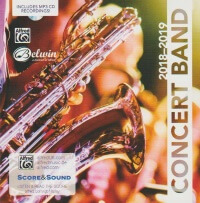
The publishing house Alfred/Belwin (USA) offers a very rounded program in its new program “Concertband 2018-2019“. From the beginner of level 0+ up to the absolutely highest demands of level 5, there is a rich program available. Original compositions by contemporary composers stand alongside popular music, classical transcriptions alongside educational works. I would like to present some highlights here, you will find the entire programme at the end of this information.
Fantasia on British Sea Songs: Sir Henry J. Wood (1869–1944) wrote his Fantasia on British Sea Songs in 1905 to commemorate the 100th year anniversary of Admiral Lord Nelson’s defeat of the French and Spanish fleets at the Battle of Trafalgar. This wonderful concert band arrangement incorporates five of Wood’s selected themes: “The Saucy Arethusa,” “Tom Bowling,” “Jack’s the Lad,” “Farewell and Adieu,” and “See, the Conquering Hero Comes.” You’ll recognize the themes, if not the original names. (SW-Grade 4; 7’58”)
LEGO Ninjago Movie, The: Selections from the Motion Picture Soundtrack: is a 2017 3D computer-animated martial arts adventure-comedy film based on the toy line of the same name. Directed by Charlie Bean, Paul Fisher and Bob Logan from a screenplay by Logan, Fisher, William Wheeler, Tom Wheeler, Jared Stern and John Whittington, it is the first theatrical film to be based on an original Lego property and the third installment of The Lego Movie franchise as well as the second spin-off of the franchise. Every register has a chance at the melody. This medley brings the tension of the film to the concert stage! From the blockbuster film music this electrifying medley is presented: Heroes; Found My Place; Operation New Me; (SW-Grade 2; 4’14”)
The Masque of the Red Death, is an 1842 short story by American writer Edgar Allan Poe. The story follows Prince Prospero’s attempts to avoid a dangerous plague, known as the Red Death, by hiding in his abbey. He, along with many other wealthy nobles, hosts a masquerade ball within seven rooms of the abbey, each decorated with a different color. In the midst of their revelry, a mysterious figure disguised as a Red Death victim enters and makes his way through each of the rooms. Prospero dies after confronting this stranger, whose “costume” proves to contain nothing tangible inside it; the guests also die in turn. Poe’s story follows many traditions of Gothic fiction and is often analyzed as an allegory about the inevitability of death, though some critics advise against an allegorical reading. Many different interpretations have been presented, as well as attempts to identify the true nature of the titular disease. The story was first published in May 1842 in Graham’s Magazine and has since been adapted in many different forms, including a 1964 film starring Vincent Price. Additionally, it has been alluded to by other works in many types of media. (SW-Grade 2; 3’13”)
One Foot s a song by American rock band Walk the Moon for their third studio album, What If Nothing (2017). The song was released as the album’s lead single on September 22, 2017. Billboard said the song “encourages the same ecstatic abandon as ‘Shut Up and Dance’ but, unlike its ’90s-worshipping predecessor, follows EDM logic with a gravity-defying beat drop and reverberating vocals.” Eli Maiman said: “It’s indicative of the album’s ‘bigger, epic sound’.” Nicholas Petricca said: “‘One Foot’ is facing the void. The last record, we felt like we had a lot of answers. This time, we have a bunch of questions. (SW-Grade 2+; 2′!5”)
Oracles of the Sirocco: Sirocco is a Mediterranean wind that comes from the Sahara and can reach hurricane speeds in North Africa and Southern Europe, especially during the summer season. This wind emanates exotic energy, creating feelings of introspection and adventure captured in the mystical messages that seem to reside in the breeze. It arises from a warm, dry, tropical airmass that is pulled northward by low-pressure cells moving eastward across the Mediterranean Sea, with the wind originating in the Arabian or Sahara deserts. The hotter, drier continental air mixes with the cooler, wetter air of the maritime cyclone, and the counter-clockwise circulation of the low propels the mixed air across the southern coasts of Europe. The sirocco causes dusty dry conditions along the northern coast of Africa, storms in the Mediterranean Sea, and cool wet weather in Europe. The sirocco’s duration may be as short as half a day or may last several days. While passing over the Mediterranean Sea, the sirocco picks up moisture; this results in rainfall in the southern part of Italy, known locally as “blood rain” due to the red sand mixed with the falling rain. Many people attribute health problems to the sirocco, either because of the heat and dust along the African coastal regions, or because of the cool dampness in Europe. The dust within the sirocco winds can cause abrasion in mechanical devices and penetrate buildings.
The Sound of the Eastern Shore: Inspired by the quaint Alabama town of Daphne —a charming gulf coast community on the eastern shore of Mobile Bay known as “The Jubilee City.” Full of cinematic melodies and exciting themes, this original work celebrates the town’s charismatic style and character in jubilant fashion. Opening with a bold fanfare, the musical journey ebbs and flows with contrasting themes showcasing every section and builds to a dramatic conclusion. (SW-Grade 3+; 3’41”)
Wonder Woman: From beginning to end, this music from throughout the hit movie, Wonder Woman, is passionate and driven by strong emotions. Catch the explosive and engaging film action in this intense, yet flowing arrangement by Victor López that captures the melodic contours, explosive dynamics, and time signature changes found in this fabulous music. This piece frequently changes tempo and often requires cueing, making it perfect for working on watching the conductor! (SW-Grade 2+; 3’57”)
In March 2019, we commemorate the 100th anniversary of the birth of some composers. They were born in March 1919:
Hubert Camenzind, (Gersau, Swiss): Camenzind was a clarinetist and saxophonist. After he had started his ten-year activity in a silk spinning mill in Gersau at school age and had been introduced to clarinet playing by a member of the local music society at the age of seventeen, he moved to Seewen in 1945, where he stayed for a short time. Then he joined the professional band of the accordionist Ernst Zwahlen from Interlaken, with whom he worked monthly for over five years in concert venues such as the Genferstube and Glocke in Bern. His services as an experienced wind player, whose role model was Jost Ribary, he lent in the further course of his career as a musician to many renowned bands from the Bernbiet, such as Fritz Mosimann, Walter Balmer senior, Lorenz Giovanelli and Viktor Gaggioli. Residing in Bönigen from 1951, he retired from professional music at the age of forty at the end of the fifties. He then found employment as a storekeeper at Mühlen AG in Interlaken, but nevertheless continued to make music part-time until 1970. A physical condition forced him to stop his career early. All the more zealously he occupied himself with composing, in which he eventually produced about 150 pieces. His best-known titles, published by Gottfried Aegler, are ‘Schwyzergeist’ and ‘Fest im Schritt’, the latter a march for wind music recorded by the papal Swiss Guard on record.
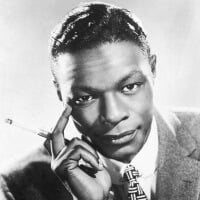
{%Nat King Cole, 1919-1965%}
‘Nat King’ Cole, (Montgobery, Alabama, USA): The American jazz musician, singer, pianist and actor died of lung cancer at the age of 46 on 15 February 1965 after a brief illness. Already in 1934, at the age of 15, he had his own band. In 1939 he founded the King Cole Trio, in which already an electric guitar was used, which was unusual at that time. The trio quickly became popular in America as an instrumental group. When Cole started singing, his actual success began. Ready 1944 the first record was found in the American charts. Many of his songs became evergreens.
Walter Alan Finlayson, (Burlingzon, Vermont, USA): Walter A. Finlayson earned a Bachelor of Science in Music Education from Ithaca College (1941) and a Master of Arts degree in Music from Columbia University (1957). He studied composition with Norman Lockwood. Although Finlayson is known as a composer/arranger, he is also a professional artist who illustrated the covers of children’s piano pieces for Boosey and Hawkes. His career as a music educator includes the chairmanship of the Katonah-Lewisboro School music department. He retired in 1974.
Luther Lincoln Henderson Jr. (Kansas City, Missouri, USA): Henderson was a master at arranging in any style, and has been a principal arranger on Broadway for decades. He had a particularly strong relationship with Dixieland music and early American jazz and blues. He grew up with this music, and knew firsthand some of the musicians who defined and developed these styles. He also became famous as a composer.
Kurt Schmidek, (Wien, at): Kurt Schmidek taught singing and oratorio at the University of Music in Vienna and was also a music critic.
Marcel Wahlich, (Zürich, Schweiz): Marcel Wahlich was born in Zurich’s old town as the son of a well-known wind instrument repairer. There he grew up in the care of a music-loving family (his father was president of the Stadtmusik from 1924 to 1946). He received his first music lessons from Gian Battista Mantegazzi in the boys’ music of the city of Zurich. After finishing school, Marcel Wahlich began dedicated music studies with Emil Fanghänel at the Zurich Conservatory – now the Musikhochschule – majoring in clarinet. After graduating, he expanded his knowledge under Paul Müller with counterpoint studies and under Volkmar Andreae he was trained as a conductor, with the then director of Stadtmusik, Gian Battista Mantegazzi, contributing his specific skills for the brass section. After his state examination, his career as an accomplished clarinettist led him for thirty years to various symphony orchestras and the Swiss Festival Orchestra Lucerne. He also taught at various music schools and grammar schools, and in 1963 he was appointed clarinet teacher at the vocational school of the Zurich Conservatory.
From 1958 onwards he conducted various wind orchestras in the upper performance classes. For many years he also presided over the music commission of the Swiss Workers’ Music Association. It is therefore hardly surprising that the existence of an efficient wind orchestra in Switzerland inspired Marcel Wahlich to study the composition of symphonic wind music. The diversity of his oeuvre is remarkable, ranging from ballet music and concert works to instructional literature and over almost 50 marches, each with its own unique sound, to expressive compositions for wind orchestras. His music is characterized by stylistic independence, melodic originality, harmony and rhythm. Marcel Wahlich has received many prizes and awards for his compositional work.