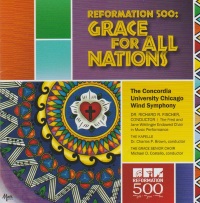
Grace for all Nation: a Reformation Document for Spiritual Music
{Reformation 500: Grace for all Nations}
Contemporary compositions of sacred music alternate with arrangements of Christian hymns by Martin Luther. Conductor Richard R. Fischer of the “Concordia University Chicago Wind Symphony“, together with “The Grace Senior Choir” (conductor: Michael D. Costello) writes in this CD “Grace for all Nations“:
“This recording project is exciting and worthwhile, allowing members of the Wind Symphony to provice members of the church, as well as elementary, secondary and college band conductors with outstanding perfomances of much previously unrecordec sacred works for winds. For band conductors and their students throughout the world, it provides a model for the performance of these works. For members of the church, it provides an ongoing music ministry of sacred works that are frequently inspired by familiar hymn tunes.
There is a great need in our chirch for live performances that include the playing of sacred music. While the greatest benefir is derived by being in attendance at a concert or worship service, a recording project such as this allows us not only to share our musical gifts with others, but also to provide the listener with an opportunity to experience over and over again the uplifting sounds of wind and percussion the boldly give glory and praise to our God.“
Compositions by Jay Bocook, Johann de Meij, Eric Whitacre, John Zdechlik, Stephen M. Lounsbrough, Christopher Nelson and William R. Brusick have contributed to this CD. Worth listening to and interesting.
The European competition leaves its mark on concert programmes.
{European Song Contest)
The “European Song Contest” has already been going on for over 60 years. You can stand by it as you like, but this series has produced some beautiful and lasting songs. So it’s no wonder that some orchestra conductors want to draw from this pot of evergreens and put them into a program. A few days ago this letter reached us:
“…I need your help. I’m planning a concert next year with songs that were part of the Eurovision Song Contest. It doesn’t have to be just winning titles. Please have a look at your great database. Thank you very much and best wishes for the New Year”! (E.B.)
Such requests are a welcome task for us. To test our database or possibly to upgrade to these questions. In this case we have completed the data and you can find these works as follows:
Category: Wind Orchestra/HaFaBra Instrumentation: Wind orchestra (Ha)
in the Full text search line: EuropeanSongContest (preferably without space between words)
Start search
Now, of course, there’s no point in just citing the part. You should also receive the corresponding background information. And we have supplemented these extensively and as optimally as possible. This is the only way to turn an information database into an informative database.
If you have unusual search queries, do not hesitate to contact us. We will help you as quickly and comprehensively as possible.
More than 30 youth wind orchestras from Austria and the partner associations South Tyrol and Liechtenstein qualified for the 8th Austrian Youth Wind Orchestra Competition. From very light to difficult literature, more than 1000 young musicians performed in the large hall of the Brucknerhaus in Linz on 29 October 2017. The versatility of the youth works and especially the different interpretations of the compulsory pieces represented a musically exciting competition for the audience.
International Youth Wind Orchestra Competition 2017
The Austrian Wind Youth of the ÖBV has collected the best of these youth orchestras on 4 CDs in two double albums. Although the two albums are not the most recent edition, we believe that this valuable information is interesting not only for youth orchestras but also for orchestras of lower to medium levels.
The CDs can be ordered directly from:
Austrian youth wind band association
Hauptplatz 10
9800 Spittal/Drau
If the CDs are out of stock, you can request individual tracks from us free of charge.
A ballet in three acts with 50 minutes playing time
“The Garden of Earthly Delights”, Troptychon of Hieronimus Bosch
Hieronimus Bosch’s mysterious images pose great puzzles to experts. They are ambiguous to interpret. In particular, the triptych picture “The Garden of Earthly Desires,” which depicts scenes that seem almost prophetic from the creation of the world to the apocalyptic end, is often the focus of expert criticism.
With a total duration of about 50 minutes, the American composer Leroy Osmon has created a musical work as monumental as this picture “The Garden of Earthly Desires“. The ballet consists of an “introduction”, three “acts” (each with four “scenes”) and an “interlude” before “Act III”. The titles for each act and scene come directly from certain sections of the Bosch painting. The inspiration for each section came from the painting as a whole and from the smallest images within the painting. The different styles of music are directly related to the images on the canvas: from the brutal to the sublime, from the abstract to the realistic. The ballet, like the painting, is a triptych (the three Acts of the Apostles) and the introduction (the third day of creation) is the upper panel of the painting. The music is a graphic representation of the Bosch painting and follows the same biblical narrative.
Composer Leroy Osmon
The composer Leroy Osmon lived and worked for several years in the Mexican state of Veracruz and was a personal friend of several members of the “Banda Sinfonice Del Gobierno Del Estado”. He composed many of the solo passages with a view to his friends. The role of the bass trombonist embodied the devil from Bosch’s vision of evil.
Act I represents the left panel and depicts Adam and Eve, the snake, various predators and the downfall of Eden.
Act II presents Noah (represented by the continuous playing of a two-part motif), lust, eroticism and the vulnerability of innocence, complete with a cast of naked figures and fantastic animals.
Act III, the right panel, has been described by art theorists as a “landscape of hell and portrays the tortoises of damnation” through a dance of perverted love and lust, death and vanity, ending with a hallucinating nightmare. Although historians and critics may have interpreted the painting as a didactic warning of the dangers of life’s damnation, the composer Leroy Osmon regarded it as a representation of a true degree of earthly joy; an erotic garden that the American writer Peter S. Beagle described as “a place of intoxication and complete freedom.
Osmond’s ballet presents a musical panorama of this lost paradise. Several of the composer’s works are represented in these compositions. When the composer received the commission for this ballet, Osmon worked on an homage to Ravel and the revisions of an early piano concerto. It was decided to include both works in the ballet with new material. There are three direct references to Ravel (the composer whom Osmon calls “the definition of my harmonic world”), as well as two complete movements of the Piano Concerto that went into the ballet. There are brief moments from other composers – including Ives, Grainger, Alwyn, Lloyd and Revueltas – who have inspired and guided Leroy Osmon harmonically and rhythmically for more than 50 years.
New catalogue with new releases 2018-2019 published by Hal Leonard Europe.
Neuerscheinungen & Highlights 2018-2019
Hal Leonard is probably the biggest European publisher. Together with its headquarters in America, the European branch presents the catalogue New Publications and Highlights 2018-2019 with music for wind orchestra, brass bands, jazz ensemble and school orchestra. The publishers Hal Leonard (us), De Haske (nl), Anglo Music (uk), Beriato (be), Amstel Music (nl), Fentone Music (uk), IberMusica (es), Scherzando and Mitropa (ch), Gobelinmusic (nl) and Harper Music Publications (uk) are represented. Although Austria and Germany are not directly represented in the publishers, there is a lot of music from these countries with works by Thomas Doss, Otto M. Schwarz, Gerald Oswald, Stefan Schwalgin, just to name a few. Japan is also present with strong works by Sathoshi Yagisawa, Hideaki Mura and Eiji Suzuki.
Themaitsch beautifully structured you will find opening music, solo works, concert pieces, pop music, film music and many other themes. We have added additional valuable information and links, numerous complete recordings, videos and scores complete the information value in our database.
Generation change in the board of the Music Information Association
In June 2018 the youngest general assembly of our organization “Music Information Association” took place. In this connection a generation change was decided at the association. In order to guarantee a smooth transition, a one-year transition phase is agreed for 2019. During this time both the technical and the organizational work will be accompanied by the old board and the work of the new management will be supported.
Doris Stadlmann was elected as the new President, replacing Helmut Schwaiger, who has been President for many years. However, he will continue to be in charge of the musical aspects of the database. Rudolf Josef Hödl was appointed as deputy, replacing Michael Hug. Michael Hug von Ruh Musik AG will continue to be the delivery partner for Switzerland.
Sigrid Stadler is the new secretary and her deputy will continue to be Juliane Pierer-Kliment. Also Johanna Heissl was confirmed as responsible for the finances of the association, her deputy is Günther Stadler. Harald Loidl of the tax office WTH-Seekirchen continues to act as the 1st auditor and Rudolf Schwaiger was appointed as the 2nd auditor.
Robbin D. Knapp as Webmaster and technical director of the data base will go in the next months into pension. His agenda will be taken over by a new partner, whom we will introduce in our next newsletter.
Once in the money swim like Scrooge Duck from Duckburg. Unfortunately, this story is not written that way. The “Music Information Association” is a non-profit association of interested musicians. Many support the association by membership fees, others by orders over the data base, by which the association can obtain additional incomes.
Many things are offered on the Internet as a free service. But actually free is almost nothing. Surely you also use Google or another search engine. There you leave then traces “in the snow”, which are then analyzed and resold to strange companies. Many practicing musicians also use YouTube or similar platforms. Many videos and sound recordings are preceded by advertisements that generate billions for the group. The copyrights are not clearly clarified and taxes? They prefer not to talk about it. Wikipedia, on the other hand, is free, but even this organization needs money to offer the service. Therefore, from time to time we ask for donations, which we as an active user also make available. However, if every Wikipedia user donates € 1,-, a few million are quickly collected.
The association for music information as operator of www.musicainfo.net is in relation to Google and YouTube a dwarf, nevertheless this data base is already for nearly 20 years in the Internet. That is to be owed to the many faithful members, who pay annually the small Obolus of ? 25, -. And this amount has remained the same since the beginning of our work. In relation to the annual inflation the membership fee has become cheaper. The web radios, where only works of which there are printed sheet music are broadcast, are available to all musicians free of charge. Without advertising! The number of datasets has increased considerably and is constantly linked to additional information. So the database is alive and active.
Even if you are not a member of our organization, but use the database www.musicianfo.net for searching or the radios, you can support the work of the association. Simply order sheet music via www.musicianfo.net from one of the freely selectable delivery partners. They pay a small commission to the association. This is € 3,- for orchestral works and € 1,- for other orders. The sheet music does not cost you more than if you order elsewhere or from the publisher. With your order you support the work of the association and thus enrich the variety of www.musicianfo.net.
Hans Hütten was a composer with broad compositional skills.
{German Composer Hans Hütten died }
On 20.10.2018 the composer Hans Hütten, popular in Germany, died in his hometown Cotbus. Hütten, who was born in 1943 in Nossens near Meissen, was a trumpeter in the then pioneer wind orchestra Meissen from 1954 to 1957. From 1957-1961 he studied trumpet with Wilhelm Simon at the Carl Maria von Weber College of Music in Dresden. From 1961-1964 he was a student at the Dresden University of Music and in 1964 he went as a trumpeter to the theatre of the city of Cottbus (today the State Theatre of Brandenburg). From 1969 he conducted the youth brass orchestra of the local music school in the Lausitz metropolis. In 1972 Hütten became a teacher and consultant for brass instruments at the Cottbus Conservatory. From 1976-1984 he led the district music corps Cottbus (500 young amateur musicians in the field of brass and minstrel music). From 1980-1984 Hütten again studied composition at the Musikhochschule in Dresden with professors Rainer Lischka and Wilfried Krätzschmar. Since 1985 Hütten lived as a freelance composer in Cottbus. His compositional work includes choral music, music for various ensembles, wind orchestras and solo literature.
The phrase “A horse! A horse! My kingdom for a horse!” is from William Shakespeare’s drama “Richard III”, when the king on the run says this after his own horse was killed. Similar was the exclamation of a Kapellmeister who had chosen a “kingdom” as the theme of his concert. And these are exactly the questions that the database www.musicianfo.net is looking forward to.
Proceed as follows: (see illustration)
{Selection criteria for “Kingdom” search}
Category: Concert/Wind/Brass Bands
Instrumentation: Concert/Wind Band (Ha) – for other wind orchestra instrumentations you then choose the appropriate selection
Difficulty level: (select desired level from – to)
in the Full text search line: Königreich Kingdom (“Könireich” fpr german word, “Kingdom” for en)
select at the Search type: at least 1 word present (to get works with either Kingdom or Königreich)
for the filter we have chosen: with sound sample
Percussion instruments are among the oldest human instruments – drum set are among the youngest!
One of the first drumsets of the Ludwig company from 1918
If you think that drums have always existed, you’re wrong, just a hundred years ago Ludwig offered a drum set. This is proven by a catalogue of the percussion instrument manufacturer from that time. Until then at least three men had to make the rhythm, one for big drum, one for snare and one for cymbals. This tradition has survived in the marching bands to this day.
From that invention of Fa Ludwig one man could now play all the essential drums and percussions on his own. This new drum set was quickly accepted by various jazz bands in New Orleans and orchestras in America. Also in Europe and other parts of the world the instrument was appreciated and the name Ludwig was a synonym for drums.
About 60 years ago my dance band also had a Ludwig drum set. An expensive investment for us at that time – a very expensive one! The stands and machines were built very filigree. I don’t think Ludwig has used a lot of inventive talent since the invention in the further development of the metallic compounds, stands and pedals. It was not until the 1970s that the Japanese drum makers Tama and others introduced double strut stands and ball joints to the market for suspension devices.
At the same time, rock music changed the drummer’s playing style and at the height of this style of music complex percussion walls and towers were built around the drummer.