

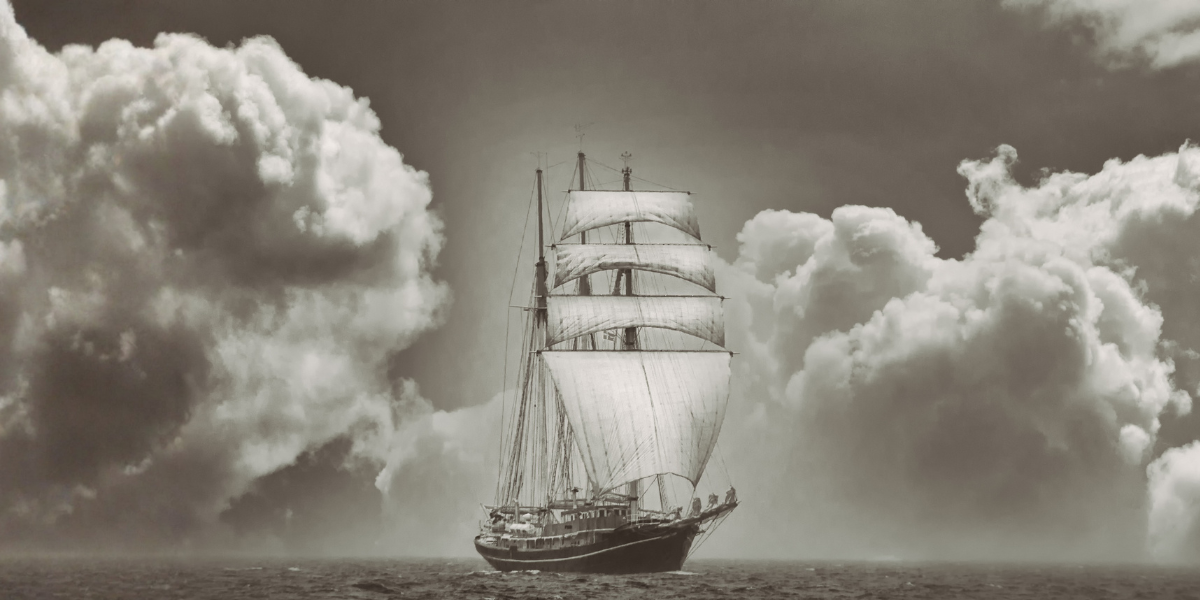
In the early morning, the sea lay calm off the Dutch coast. Not a breath of wind stirred the sails, and even the seagulls seemed to be waiting for the first note. Then an unusual ship appeared on the horizon. It bore the name of an ancient maritime myth, yet it arrived with a very different cargo: sheet music, sheet music, and more sheet music. The “Flying Dutchman” returned from a world tour. In this story, we are not referring to the legendary figure said to roam the seas for centuries. The Flying Dutchman is the Dutch music publisher Molenaar. Instead of gold, spices, or exotic goods, the ship was laden with new musical works. Its goal was to deliver this collection into the hands of conductors and active musicians (of course, female musicians are also included).
Where had it been, what route had it taken? We investigated and reconstructed the exact journey. The first stop was:
Belgium
Here it discovered two compositions by Jean-Pierre Heack: “Appaloosa” is primarily the name of a horse breed. In this work, however, it serves as the title for the story about the impressive journeys these animals undertake through the beautiful landscapes of the northwestern United States – the area from which they originally hail. Along the banks of the Palouse River, we also encounter an indigenous tribe of the same name… (Intermediate, 4’30)
“Terra Nostra” invites us to reconsider the beauty and fragility of our planet. With a powerful musical narrative, Haeck takes the audience on a journey through the four fundamental elements that have been considered the building blocks of all life since antiquity: air, water, fire, and earth. Each element is represented by its own sonic identity – full of symbolism and expression. (Upper-intermediate, 12’30)
Then the crew sailed on to:
France
There they found three contemporary composers: Lauren Weisbeck. Laurent Weisbeck’s Concertino 4.0 for trombone quartet solo and advanced wind orchestra presents trombonists with diverse technical demands. The work requires precise dynamic changes, differentiated articulations, and secure playing in extreme registers. Rhythmic complexity through polymetrics and syncopation demands intensive coordination within the ensemble. Solo passages and dialogues with the orchestra also require technical proficiency and musical expressiveness. Mastering these challenges promotes both the technical skill and the artistic expressive ability of the musicians. (Advanced, 8′)
Alexandre Carlin describes the moment of balance between day and night in “Equinox: Shadow and Dawn“. A monumental stone stands between a dark blue world of shadow and the golden dawn; a sunbeam symbolizes the transition. The approximately 6 1/4-minute composition follows an A-B-A form. The work has a clear musical structure with a symbolic representation of darkness, light, transition, and balance. (Intermediate)
In “Roma Aeterna“, the composer describes a musical journey through Rome, connecting various historical and cultural sites. The tour begins with the tranquil “Sunrise in Roma” in 4/4 time, then leads via the Appian Way and the Roman Forum. With “Plazas and Fountains”, the music comes alive in a fast, playful 6/8 time. “The Vatican” then provides a contemplative contrast with its calm tempo and religious character. In the “Colosseum”, tension builds through a fast tempo and the irregular 7/8 time, depicting a gladiatorial combat. In the concluding “Roma Aeterna”, earlier motifs reappear. This connects the individual stations and musically emphasizes the timeless significance of Rome. (Upper-intermediate, 9′)
Guillaume Detrez: La Montagne de Watten – In Houtland, Watten lies on the edge of Flanders. At 72 meters high, the Wattenberg is the westernmost link of the low mountain range in Flanders. A magnificent theme that refers to the mountain and its ascent. Once at the top, we have a spectacular view over Flanders. Then the mill starts, accompanied by a medieval theme symbolizing the abbey. In the finale, several overlapping themes resound. (Upper-intermediate, 6′)
With Nordic Lights, you offer your audience a spectacular and captivating musical experience. Inspired by the fascinating beauty of the Northern Lights, this work takes listeners on an accessible and enthralling sonic journey. From the very first bars, the audience is drawn into a mysterious, cool atmosphere, which is soon carried by expressive themes and striking contrasts. Rich orchestral colors, controlled energy, and a brilliant finale: Nordic Lights brings out all the qualities of the orchestra and immediately captivates the audience. As an ideal highlight of a concert program, this work combines modernity, emotion, and impact, guaranteeing an enthusiastic reception from musicians and listeners alike. (Upper-intermediate, 7’30)
Guillaume Detrez’s “Pharaoh’s Legacy” for advanced wind orchestra musically describes the mysterious legacy of the pharaohs. Solemn processional sounds, ritual sections, oriental timbres, and changing time signatures create a contrasting atmosphere. Modulations and rhythmic changes lead through musical images of ceremonies, scents, and desert landscapes. The work builds to a dynamic climax and concludes the formal arc in the finale, returning to the beginning. (7:30)
After France, the captain set course for
England
Dean Jones provided four compositions: #RustyOXI (Intermediate, 4’40), The Ancient Ruins (The Wonders of the World) and Sound Style Studio! (both Beginner, 6’30 and 7’15), as well as The Black and Gold, composed for the “1st Whitstable Scout Group Band”. The band was founded in Kent in 1919 and embodies the musical tradition of the Scout movement. Originally conceived as accompaniment for Scout activities, it developed into a renowned brass band that is also open to the local community. A central work that reflects this tradition and is dedicated to the band is Dean Jones’ composition “The Black and Gold (Spirit of 1907)”. The piece combines march-like rhythms with modern elements and, through modulations and a solo for glockenspiel and trumpet, recalls the values of Scouting.
Now the Flying Dutchman set course back to the mainland and landed in
Portugal
There, two composers were found: first, Vitor Resende with his composition “O Xerife“, an approximately 5 3/4-minute Paso Doble for advanced wind orchestra. Dedicated in 2022 to the “Banda Marcial do Vale” for their participation in the “Vila d’Altea” competition, the work begins solemnly and powerfully with a striking main theme that expresses the authority and presence of a sheriff. The brass section shapes the heroic sound character. In the subsequent Agitato section, a dynamic, narrative scene unfolds with agitated rhythms, sonic contrasts, and increasing tension. Precision, articulation, dynamic control, and a balanced interplay of all registers are crucial for a convincing interpretation.
Os Moinhos da Pinhoa (The Windmills of Pinhoa). Pinhôa is known for its historic windmills, which recall the former use of wind power for grinding grain. Today, they symbolically represent time, change, and the connection between humans and nature. In Vitor Resende’s composition Os Moinhos da Pinhoa, landscape and history are musically depicted: the Moderato conveys tranquility, the Allegro movement and wind power, the modulation change, and the Lento remembrance.
The Walls of Monção is a programmatic and expressive work, inspired by the legends and people of Monção, Portugal, whose stories echo through time. The musical design unfolds narratively, alternating between moments of great intensity and martial character, and lyrical and contemplative sections. Throughout the work, harmony and sound textures explore contrasts in dynamics, instrumental coloring, and thematic development, creating an epic, cinematic atmosphere. The composition follows a progressive structure that culminates in a grand finale, highlighting the symbolic and historical strength of the underlying theme.
Then it continued to
Spain
There they found a composition that, while not about Spain, concerned Sicily. And the island was on the planned route anyway. Juan A. Perez dedicated himself to the city of Syracuse, known for its Greek history, theater, and connection to Archimedes. This historical and cultural diversity forms the basis for Juan A. Perez’s composition “Siracusa“. The approximately 6 3/4-minute work for intermediate wind orchestra depicts the city not chronologically, but through musical moods. Quiet sections symbolize memory and culture, while faster parts express movement, conflict, and vibrancy. Overall, a musical city portrait emerges, conveying the history and atmosphere of Syracuse sonically.
Next, it went to
Malta
There they found the Camilleri family. We could not determine how closely the various individuals were related. In any case, Rene Camillerie provided two works: 1. EPOS (Clash of the Gods) for upper-intermediate wind orchestra (6’50) and 2. To the Point for intermediate wind orchestra (3′). Anthony Camillary created the composition Iubilaeum MMXXV, a concert march for advanced wind orchestra, composed for the Holy Year of Hope 2025. The work combines traditional march elements with symphonic development, alternating between festive celebration and contemplative reflection. Harmonic changes, shifting sound densities, and the evolution of themes reflect the tension between hope and uncertainty. The concluding reprise integrates the musical material, thereby expanding the traditional form of the concert march.
Now the ship set course through the Suez Canal to:
Japan
There they met the composer Tohru Kanayama with two new works: Brazilian Romance (Intermediate Wind Orchestra, 5’20) and “Soaring High Above“, which literally means “to ascend high” or “to grow beyond oneself”. In Tohru Kanayama’s composition of the same name, this image is realized through energetic and dynamic music. Each instrument group gets its own solo moments and can showcase its sonic possibilities. The percussion, especially the mallet instruments, also plays a prominent role. The continuous swing and groove create a lively, funky, and driving character. The title thus stands for both the emergence of individual sections and the collective musical development of the entire ensemble.
Then it returned home, and the sheet music collection was supplemented with local composers.
Netherlands
Geert Schrijvers provided two compositions and two arrangements: Concerto for a Rainy Day (by Electric Light Orchestra) and O Mio Babbino Caro by Giacomo Puccini, as well as Morias Enkomion for piano solo and advanced wind orchestra (12′) and Pressure and the Ticking Clock for upper-intermediate wind orchestra, musically describing the development of pressure and time constraints. In the “Nervous Build”, increasing unease arises. From bar 18, this intensifies through “Stressfully Fast” to urgency and overwhelm. The calmer section “Calmly” provides a brief relief. However, this remains temporary. From bar 87, the fast, stressful movement returns. The changing tempi and time signatures make the time pressure immediately palpable. The subtitle “It all starts here” indicates that stress begins with an initial impulse and can progressively intensify.
Eric Swiggers composed “Sparkling Pleasure“, written on the occasion of the 125th anniversary of the Ons Genoegen Music Association from Wijdenes. The title humorously alludes to the association’s name and its vibrant musical tradition. The composition opens with a festive fanfare full of energy and joie de vivre, followed by a tender Andante that offers space for reflection and emotions. After a reprise of the opening theme, the work flows into an Andante con grandezza, where the two main themes intertwine – symbolizing connection and future. An accessible, festive work and the ideal concert opener.
And then there is the composition “De Verschrikkingen van het ijs en de Duisternis” by Harrie Janssen for professional wind orchestra, with a duration of 35 minutes. The composition deals with the Austro-Hungarian North Pole Expedition (1872–1874) under Carl Weyprecht and Julius von Payer. This started with the goal of exploring the Northeast Passage. After getting stuck in the pack ice, the crew discovered Franz Josef Land, disproved the theory of an ice-free Arctic Ocean, and mapped parts of the Arctic for the first time. The expedition later inspired Christoph Ransmayr’s novel “The Terrors of Ice and Darkness” (1984), which addresses human hubris and forces of nature, as well as Harrie Janssen’s composition for wind orchestra, which musically translates the dramatic events. Both works show how historical events are reinterpreted through literature and music. The orchestral material is available for loan from the publisher only.
This composition therefore has a connection to
Austria
perhaps that explains why a composition from Austria got lost in the “Flying Dutchman” collection. Michael Geisler is represented with two works for intermediate wind orchestra: The Last Mammoth and On the Peak, which musically describes the path to the summit and is divided into a triumphant introduction, two rhythmic “Pop style” sections, a mysterious “Misterioso” part, and a fast “Allegro” finale. The composition thrives on contrasts, increasing energy, and precise ensemble playing.
With a clever trick, even non-members can access all background information on the compositions mentioned here (excluding radio tracks). We wish you much enjoyment.
All discoveries of the Flying Dutchman can be found in Molenaar New Publications 2026-2027
Helmut Schwaiger




