

The Paul Huber Year 2026 shines a spotlight on a composer who has had a lasting impact on Swiss wind music. To mark this occasion, the Music Commission of the Swiss Wind Music Association announced an international composition competition. The competition sought a new work for wind orchestra that further develops a theme from one of Paul Huber’s compositions in the spirit of a musical metamorphosis.[1]
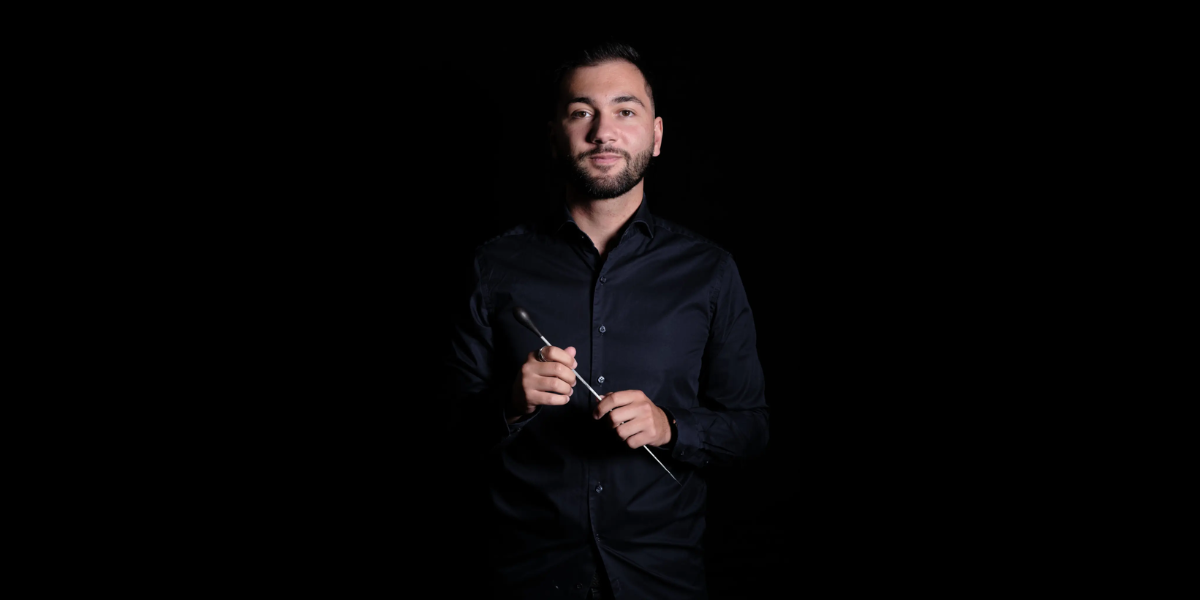
The competition was won by Théo Rossier, a composer from Vaud born in 2002, with his composition“Ab Uno.”The world premiere is scheduled for Sunday, September 13, 2026, as part of the gala concert for the SWISS WINDBAND AWARD Conducting Competition at the Kurtheater in Baden. The work will be performed by the Schweizer Armeespiel Symphonic Wind Orchestra in the presence of the composer.[2]
Paul Huber and His Contribution to Swiss Brass Music
Paul Huber lived from 1918 to 2001 and is considered one of the most influential Swiss composers of the 20th century. His work continues to hold special significance for the Swiss wind music scene to this day. The Paul Huber Year commemorates, in particular, the fact that 2026 will mark the 25th anniversary of his death.[3]
The tribute is not limited to the performance of historical works. Rather, the aim is to carry on Huber’s musical vision from a contemporary perspective. The composition competition thus bridges the past and the present: Contemporary composers were invited to engage with Huber’s music and develop an original composition based on it.
The call for submissions allowed participants a certain degree of creative freedom. The work was to be suitable for a top-tier or first-category wind orchestra. The duration and specific classical form could also be chosen freely. Works with a narrative plot, however, were not permitted.[1]
Eleven submissions from across Europe
Eleven composers from across Europe participated in the competition. The submitted works were judged anonymously. A jury of experts—comprising Emilie Chabrol, Stéphane Delley, and Felix Hauswirth —was responsible for the evaluation. The jury members first evaluated the compositions independently of one another based on the specified criteria.[2]
At the joint session,“Ab Uno”made the strongest impression on the jury. The decision was made before it was known who had composed the piece. Thus, Rossier’s composition was not selected based on the composer’s name or career to date, but rather on its musical quality and the compelling execution of the competition’s requirements.[4]
Théo Rossier: Composer and Conductor
Théo Rossier was born on June 11, 2002, in the canton of Vaud. He began composing at the age of 14 and was initially self-taught. Later, he took courses in harmony at the Lausanne Conservatory as part of the wind orchestra conducting program. He also earned a bachelor’s degree from the Bern University of the Arts.[5]
Rossier has previously gained experience composing for brass bands and wind orchestras. In 2022, he won first prize at the European Composition Competition for Brass Bands with“Stendhal’s Syndrome.”[5] His work thus combines composition with practical experience in wind orchestra music and conducting.
The Musical Concept Behind “Ab Uno”
The title “Ab Uno” can be roughly translated as “from one” or “out of one.” The title thus refers to the compositional starting point of the work: Rossier takes up the opening measures of Paul Huber’s “Adagio for Solo Cello.”[4]
However, “Ab Uno” does not simply copy the model. The theme is used as a musical seed in terms of rhythm and melody. As the composition unfolds, it appears in various forms and is integrated into changing sonic and musical contexts. An original idea thus gives rise to an independent, multi-layered progression.[4]
This approach is in line with the fundamental concept of the competition. In this context, “metamorphosis” does not simply mean the adaptation or orchestration of an existing theme. The musical material is transformed, further developed, and placed in new contexts. The connection to Paul Huber remains recognizable, while Rossier simultaneously develops his own musical language.
The jury particularly highlighted the clear and coherent structure of “Ab Uno.” The innovative musical language and the nuanced, colorful instrumentation were also recognized. In this way, Rossier uses the sonic possibilities of the wind orchestra not only to effectively present the theme, but also as an independent compositional device.[4]
Memory as a Creative Process
The Paul Huber Year 2026 demonstrates how a musical tribute can go beyond a mere retrospective. While Paul Huber’s work serves as the historical point of reference, the competition also looks toward the future of wind orchestra repertoire.
“Ab Uno” is a composition that draws on a specific work by Huber yet goes beyond mere quotation. Théo Rossier transports the source material into a new sonic and structural context. The world premiere in September 2026 will thus not only be a tribute to Paul Huber, but also an example of how contemporary composition can productively build upon tradition.
Sources
[1] Swiss Wind Music Association —“Call for Entries: Paul Huber Year 2026 Composition Competition”— 2025 —
[2] Swiss Wind Band Association / Unisono —“Paul Huber Year 2026: Théo Rossier Wins the Composition Contest”— 2026 —
[3] Swiss Wind Band Association —“That Was the EMF 2026”— 2026
[4] BRASS BAND NEWS —“Paul Huber Year: Théo Rossier Wins the Composition Contest”— 2026 —
[5] BRASS BAND NEWS —“Paul Huber Year: Théo Rossier Wins the Composition Competition”— “About the Composer” section — 2026
[6] Théo Rossier —“Ab Uno” and event information regarding the world premiere — 2026
(This article was generated by AI)




