Monday, February 16, 2026
Home Blog

Obituary of Dr. Paul M. Noble (1935-2025) – A life for music between Virginia and England

On August 19, 2025, Dr. Paul M. Noble, an extraordinary publisher, arranger and musicologist whose work had a lasting impact on the world of wind music, passed away. The sad news has only now reached us – a moment to pause and pay tribute to the multifaceted work of a man who dedicated his life to music and the connection between the USA and England.


A musical heritage between two continents

Dr. Paul M. Noble, who spent the majority of his life in Virginia (USA), was not only a gifted arranger, but also a passionate custodian of British musical culture. As the 32nd great-grandson of Alfred the Great, King of England, he felt a lifelong connection to the Cotswolds, Gloucestershire, Winchester and Cheltenham – regions that also influenced the composer Philip Lane, with whom Noble shared a special artistic bond. This deep connection with England permeated his entire oeuvre and made him a bridge builder between the American and British brass music traditions.

Noble began arranging for wind bands and jazz ensembles while in high school, a passion he continued to pursue during his bachelor’s and master’s degrees at the Shenandoah Conservatory of Music, Indiana University and the Catholic University of America. His studies also took him to the Universities of Michigan and Virginia, where he worked not only as a student, but also as a teacher and conductor at all levels, from school ensembles to professional ensembles.


A publisher with vision: Bandmusicpdf.net and collaboration with big names

Noble’s name is inseparable from Bandmusicpdf.net a publishing house which, as co-founder and arranger, he made into one of the most important sources for brass music literature. His arrangements – including works by John Rutter, Philip Lane, William Walton, Gordon Jacob and Sir David Willcocks – are performed worldwide and are a regular feature of festival programs in the USA and the UK. As a Licensed Edition Publishing Partner of Oxford University Press and a member of the American Bandmasters Association, he has set the standard for quality and innovation in the field of wind band music.

A particular highlight of his career was the CD recording of his arrangements by the Birmingham Symphonic Winds under the direction of Keith Allen, which was released on Arabesque Recordings. This recording documents not only his craftsmanship, but also his ability to unite British and American musical culture.


A legacy that continues to resonate

Dr. Paul M. Noble leaves behind an extensive body of work of over 350 arrangements played in concert halls, schools and festivals around the world. His commitment to brass band music, his passion for British composers and his tireless work as a publisher, teacher and conductor make him a formative figure in the music scene of the 20th and 21st centuries.

His death is a great loss to the music world, but his legacy lives on – in the scores he arranged, in the ensembles that play his works and in the people he inspired. May the music he loved so much pay him a final tribute.


“Music is the language of the soul – and Paul M. Noble gave it a voice.”

WMC-Kerkrade launches ticket sales for the 2026 anniversary year


The World Music Contest (WMC) Kerkrade celebrates its 75th anniversary in 2026, marking a historic milestone in the history of the international brass music scene. Tickets for the 20th edition of the prestigious festival have officially been on sale since Saturday, January 17, 2026. Interested parties can purchase them online via the official WMC website or on site at HuB.Kerkrade.


A festival of superlatives

The WMC is considered the “Olympic Games of wind music” and offers a unique program from 9 July to 2 August 2026. Over 250 orchestras and bands from 31 countries and five continents will take part in the competitions. The festival promises not only world-class brass music, but also a varied supporting program with over 450 events at various locations in Kerkrade, including the Rodahal, the Parkstad Limburg Stadium, the Kerkrade Theatre and the Market Square.

Highlights of the anniversary year

  • Opening by the Blue Devils: The renowned American corps “Blue Devils” will perform the official opening parade on July 9, 2026 – a European debut that will be the prelude to an unforgettable festival.
  • Competitions and concerts: In addition to the traditional concert, marching and show competitions, the WMC presents an exclusive series of concerts with top ensembles such as the Orchestre de la Garde Républicaine, the Brass Gala with the Cory Band and the finale of the International Conducting Competition with the Royal Military Band Johan Willem Friso.
  • WMC Fringe Festival: On four weekends, spontaneous musical performances in the streets of Kerkrade create a lively and convivial atmosphere.
  • Blow! on the market square: From Thursday to Sunday, the market square is transformed into a stage for top bands and the opening parade – a hotspot for music, parties and entertainment.

A festival with tradition and a future

Since it was founded 75 years ago, the WMC has provided a platform for over a quarter of a million musicians from all over the world. The 20th edition is all about fun, excitement and conviviality and underlines the international appeal of the festival. Festival director Bart van der Roost emphasizes the renaissance of the WMC, which is reflected in the large number of participants, the dedicated team of volunteers and the strong regional support.

Secure tickets

Tickets for all WMC 2026 events have been available for purchase since January 17, 2026. The full program and the online ticket store are available on the official website. Take the opportunity to be part of this unique anniversary and experience the fascination of brass music in Kerkrade.


Sources:

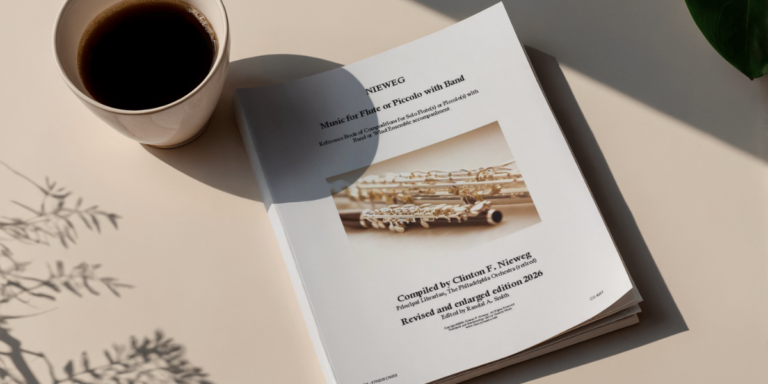
Clinton F. Nieweg’s “Music for Flute or Piccolo and Band” – An indispensable reference work for flutists, conductors and teachers

With “Music for Flute or Piccolo and Band”, Clinton F. Nieweg, former chief librarian of the Philadelphia Orchestra and recognized expert for critical editions, has created a standard work that systematically records over 1,000 works by more than 700 composers from the years 1625 to 2025. The book is aimed at flutists, piccolo players, conductors, music teachers and ensemble leaders who are looking for a comprehensive and practice-oriented repertoire directory for flute or piccolo with orchestral or wind ensemble accompaniment.


Content and structure of the reference work

1. scope and research basis

Nieweg’s work is based on over 15 years of research and documents compositions from the Baroque to the present day – from Mozart to Romanticism and Modernism to Henry Mancini. Each entry contains detailed metadata, which is essential for practical use:

  • Composer and arranger: Clear attribution of authorship.
  • Instrumentation: Detailed overview of the instrumentation, including solo instrument and accompaniment (wind orchestra, symphony orchestra, chamber music ensemble).
  • Duration: Indication of the approximate playing time.
  • Level of difficulty: Classification to assess the technical and musical requirements.
  • Publisher and availability: Information on sources of supply, costs, copyright status and rental options.
  • First performance and reception: Historical classification and, if available, references to recordings or important performances.
  • Hyperlinks: Direct references to digital resources, sheet music examples or audio carriers.

2. structure and user-friendliness

The book is organized thematically and alphabetically, making it easy to find your way around. A detailed index facilitates the search for specific composers, works or epochs. The clear tabular form and the uniform presentation of metadata make it an efficient tool for program planning and repertoire selection.


Practical use for musicians and conductors

1. repertoire planning and program design

For conductors and ensemble leaders, the work offers a sound basis for selecting suitable pieces – whether for concerts, competitions or educational purposes. The indication of the level of difficulty and instrumentation helps to adapt the repertoire to the abilities of the ensemble.

2. educational use

Music teachers and students benefit from the comprehensive overview, which includes not only standard literature but also lesser-known works. The detailed information on availability and costs supports the procurement of sheet music.

3. scientific and historical research

Thanks to the meticulous documentation of premieres, reception and historical contexts, the book is also suitable for musicological work. The hyperlinks to digital resources expand the research possibilities.


Available editions and sources of supply

The reference book is available in the following formats:

  • PDF version: Practical for digital use, including search function and hyperlinks. The file is provided with a watermark.
  • Spiral binding: Ideal for daily use in the rehearsal room or office. Robust binding and clear layout.
  • Combination package (PDF + spiral binding): For users who prefer both the digital and the physical version.

Sources of supply include specialized music publishers and online platforms such as musicainfo.net and its partners.


Conclusion: A milestone in flute literature

Clinton F. Nieweg’s “Music for Flute or Piccolo and Band” is an indispensable tool for anyone professionally or pedagogically involved with flute and piccolo literature. The combination of historical depth, practical relevance and user-friendly presentation makes it a standard work that no library should be without.


Sources:

New Year’s Eve with brass music – a playlist for the festive turn of the year

We wish all friends of Musicainfo.net a good start into the new year with our “Happy New Year” playlist lasting over four hours!

The playlist is also available in our new radio apps:

Note: https://musicainfo.radio and the Musicainfo Radio apps are only available to full members. Use the same login and password as for https://de.musicainfo.net

The turn of the year has always been a special moment in brass music. Between retrospection and new beginnings, it is precisely those works that are festive, rhythmic and tonally balanced that unfold their effect. Our New Year’s Eve playlist “Happy New Year” picks up on precisely this area of tension and offers a carefully compiled selection for wind music and wind orchestra fans.

The focus is not on individual “hits”, but on a musical sequence that carries the evening – from the early festive character to the transition into the new year.

Reliable classics at the turn of the year

“On the beautiful blue Danube”

The Danube Waltz is an inseparable part of New Year’s Eve. In the wind orchestra version, the work develops a special clarity: lines become more transparent, the pulse remains stable and the typical Straussian momentum is nevertheless retained. Johann Strauss Sohn shows here how timeless this music is – even outside the classical string orchestra.

“Radetzky March”

This march should not be missed as an energetic counterpoint. Rhythmic precision, clear articulation and the familiar form make it an effective highlight of the playlist. The work by Johann Strauss Vater stands for verve and festivity and is a proven crowd-puller.

“Auld Lang Syne”

The emotional core of the turn of the year. In wind orchestra arrangements, this traditional song has a particularly immediate effect. Warm tone colors and a calm arrangement create space for reflection and community. As Auld Lang Syne, it marks the moment of transition – musically simple, but effective.

The main works between the highlights

What makes this playlist special is the selection of works between the well-known fixed points. They give the program structure and depth.

Concertante overtures

These pieces open the evening with a festive character and concertante ambition. They present wind music as fully-fledged concert literature – with clear themes, suspenseful arcs and colorful instrumentation.

Sophisticated marches

In addition to the well-known classics, there are marches that impress with their musical substance. Differentiated dynamics, harmonic subtleties and clean form make them more than just rhythmic accompaniment music.

Gallops and fast character pieces

These works bring lightness and movement to the playlist. They set specific accents, enliven the musical progression and demonstrate the technical and rhythmic strength of modern wind orchestras.

Intended for brass music fans

This New Year’s Eve playlist is aimed at people who appreciate brass band music – as a listening pleasure, as a club and concert culture or from their own active experience. It combines tradition with musical quality and creates a harmonious setting for the turn of the year.

Whether heard consciously or as a festive accompaniment:

This selection shows how versatile, sustainable and festive brass music is at the end of the year.

Note: https://musicainfo.radio and the Musicainfo Radio apps are only available to full members. Use the same login and password as for https://de.musicainfo.net

Christmas music – with a difference: why “The Little Lord”, “Three Hazelnuts for Cinderella” and “The Nutcracker” are part of the festive season.

The Christmas season is not only a time of reflection and tradition, but also a time when certain films, ballets and musical works play a special role. While classic Christmas songs and stories are omnipresent, there are works that are only indirectly associated with the festivities, but are nevertheless firmly part of the pre-Christmas spirit. These include the movie “The Little Lord”, the fairytale film “Three Hazelnuts for Cinderella” and the ballet “The Nutcracker”. But what makes these works so special and how do they contribute to the festive atmosphere? A central aspect is the music, which plays a major role in these works – and this is also the starting point for Josef Jiskra’s arrangement for clarinet quartet, which interprets these pieces in a new way.

What the works have in common: why they fit the Christmas season

All three works combine a profound emotional level with themes such as family, solidarity and hope – values that are particularly emphasized at Christmas time. “The Little Lord” tells the story of a boy who cracks the rough shell of his grandfather through his warmth and thus brings the family back together. This message of reconciliation and love fits perfectly into the pre-Christmas period, in which harmony and community take center stage.

Three Hazelnuts for Cinderella“, on the other hand, combines the classic fairytale world with a wintry backdrop reminiscent of snow, cold and cozy evenings. The music by Karel Svoboda emphasizes this mood and creates an atmosphere that fits seamlessly into the Christmas season

Finally, “The Nutcracker” is a ballet about magical dreams and childlike joy – themes that are closely associated with the pre-Christmas period. Pyotr Ilyich Tchaikovsky’s music transports these dreams into sound, creating a festive, almost fairytale-like atmosphere

Music as a central element

The music in these works is not just an accompaniment, but a central element that enhances the emotional impact. In “The Little Lord”, the film music underscores the dramatic and heart-warming scenes, creating an atmosphere that immerses the viewer in the story. The title melody of “Three Hazelnuts for Cinderella” is a catchy tune that is immediately associated with the Christmas season and creates a nostalgic mood. “The Nutcracker”, on the other hand, is known for its catchy melodies and character dances, which are recognized as Christmas music even outside of the ballet

Tradition and nostalgia

All three works have been an integral part of pre-Christmas programming on television or in theaters for decades. They evoke memories of childhood and thus create a link between the generations. This tradition makes them an indispensable part of the Christmas season, even if they do not explicitly tell Christmas stories.

The role of music in the works

“The Little Lord” – warmth of heart in sound
The music in “The Little Lord” is restrained but effective. It accompanies the action and reinforces the emotional moments without being intrusive. The film music creates an atmosphere that immerses the viewer in the story and underlines the message of love and reconciliation. (Unfortunately, we are not aware of an arrangement of the film music for wind orchestra)

“Three Hazelnuts for Cinderella” – Winter fairytale music
The music by Karel Svoboda is a central component of the film. The title melody is an absolute earworm and is immediately associated with the Christmas season. The music creates a wintry, almost fairytale-like atmosphere that fits perfectly with the plot and transports the viewer into a world full of magic and romance.

“The Nutcracker” – Magical dreams in sound
Pyotr Ilyich Tchaikovsky’s music for “The Nutcracker” is a masterpiece that perfectly captures the magical atmosphere of the ballet. The catchy melodies and character dances are known worldwide and are often associated with the Christmas season. The music conveys the dreams and childlike joy at the heart of the story, creating a festive mood that captivates the audience

Josef Jiskra’s arrangements for clarinet quartet: a new interpretation of festive music

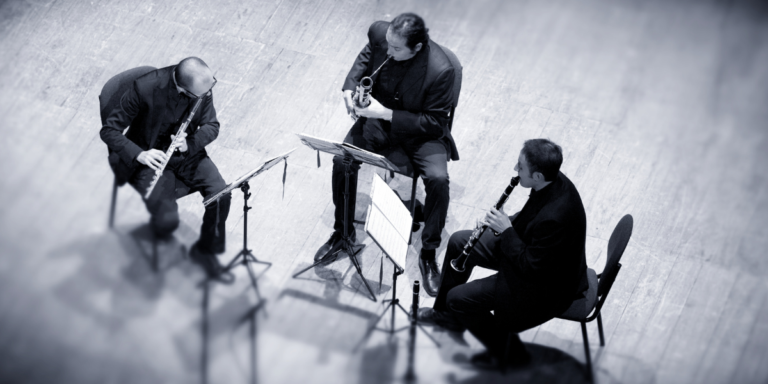
Josef Jiskra has specialized in arrangements for clarinet quartet and has thus created a new way to experience the music of these works. His arrangements make it possible to hear the well-known melodies in a new timbre that interprets the festive character of the pieces in a different way. The clarinet quartet offers a special variety of sounds that is ideal for the interpretation of film music and ballet pieces. The clarinet can play soft, lyrical passages as well as lively, rhythmic sections. This makes them particularly suitable for capturing the emotional depth and festive mood of these works. Jiskra’s arrangements make it possible to experience the music from “Three Hazelnuts for Cinderella” in a new context. The clarinet ensembles create an intimate, chamber music atmosphere that brings the listener even closer to the music. This expands the Christmas experience by presenting the familiar melody in a new, surprising sound world.

Christmas music beyond the classics

“The Little Lord”, “Three Hazelnuts for Cinderella” and “The Nutcracker” show that Christmas music doesn’t just have to consist of classic Christmas carols. These works combine emotional depth, family values and a magical atmosphere that perfectly suit the festive season. The music plays a central role and creates a mood that transports the audience into a world full of hope, dreams and community.

Josef Jiskra’s arrangement for clarinet quartet offers a new perspective and adds another facet to the Christmas experience. They show that Christmas music can be diverse – and that even works that are not explicitly Christmassy have a firm place in the pre-Christmas period.


Sources:

Travis J. Weller – The “Concert Trios” as a pedagogical concept for musical diversity and social development

Travis J. Weller, born in 1973, is an American composer, arranger and music educator whose work is characterized by a close connection between artistic quality and pedagogical standards. For over two decades he has been involved as a band director, lecturer and advocate of music education. His compositions, especially the series of “Concert Trios“, offer students of different voice groups the opportunity to make music in flexible formations – an opportunity that is often limited in the traditional ensemble repertoire. The 18 trios in this collection are not only musically challenging, but also encourage collaboration, individual musicality and self-confidence in young musicians through their variety of cultures, styles and composers.

Travis J. Weller: Career and pedagogical orientation

Travis J. Weller studied music education with a focus on tuba and conducting at Grove City College (bachelor’s degree) and completed his master’s degree in music education at Duquesne University. He is currently working on his doctorate at Kent State University. He has served as the band director at Mercer Area Middle-Senior High School since 1995 and is also the Assistant Chair for the Messiah University Music Department. His focus is on promoting young musicians through accessible but challenging chamber music that develops both technically and musically.

Weller sees himself as an active arranger and composer whose work is specifically tailored to the needs of students and teachers. His approach combines musical excellence with pedagogical practicality: the “Concert Trios” are designed to cover different levels of development – from simple keys and time signatures to more complex technical challenges. This allows teachers to select pieces according to the students’ level of ability and thus support individual development.

The “Concert Trios”: diversity, collaboration and musical development

The “Concert Trios” series comprises 18 flexible trios that are deliberately arranged for different voice groups and instrument combinations. This flexibility is a key feature of the collection: it allows students to perform together regardless of the instrumentation of their ensemble – an opportunity that is often lacking in the classical repertoire. The works cover a wide range of styles and cultural influences, from classical to contemporary elements. This not only familiarizes students with different musical traditions, but also teaches them to engage with different soundscapes and work together to find solutions.

The educational significance of the trios lies in several aspects:

  • Promoting cooperation: By working in small groups, students develop a sense of ensemble playing, mutual listening and adaptability.
  • Individual challenges: The pieces are designed to gradually expand technical and musical skills – from simple melodies to challenging rhythms and harmonies.
  • Strengthening self-confidence: Experiencing success in rehearsals and performances promotes motivation and confidence in one’s own abilities.
  • Cultural and stylistic diversity: The exploration of works by different composers and epochs broadens musical horizons and encourages students to reflect on their own preferences and strengths.

Travis J. Weller’s “Concert Trios” are more than a collection of chamber music pieces – they are a pedagogical concept that understands musical education as a social and cooperative process. The diversity of the works and the flexibility of the instrumentation enable pupils to learn together, experiment and inspire each other. For conductors, music teachers and choir leaders, the trios offer a valuable tool to promote not only technical skills, but also teamwork, creativity and self-confidence. At a time when musical education often suffers from a lack of resources, Weller’s compositions show how targeted arrangements and well-thought-out didactics can have a lasting impact on young musicians.

New features on musicainfo.net: Extended functions and optimized data for conductors, music teachers and active musicians

The musicainfo.net database has comprehensively expanded its content and functions to enable conductors, music teachers, choir leaders and active musicians to research and plan programs even more efficiently. The latest updates include revised compulsory piece lists, an expanded literature database, thousands of program notes and practical download and correction options. This article presents the most important new features and shows how users can benefit from them.

  1. Revised and supplemented compulsory piece lists for Germany, Austria and Switzerland

The lists of compulsory pieces for competitions and competitions in Germany, Austria and Switzerland have been updated and expanded. The lists are now fully accessible via the database and provide a reliable basis for the selection of works for competitions. Conductors receive an up-to-date overview of the prescribed works, which facilitates the planning of competition programs. Music teachers can prepare their students specifically for the requirements. Active musicians can quickly find the relevant pieces for their participation in competitions.

  1. Integration of the “Austrian Youth Literature Database”

The database has been expanded to include the “Austrian Literature Database“, which specifically includes works by Austrian composers and arrangers. This supplement provides a comprehensive overview of musical literature from Austria and enables a targeted search for regional works.

  1. Expansion of the “program notes” to almost 8,000 works

Program notes for almost 8,000 works are now available for full members. These notes provide background information on compositions and performance practices that are essential for program design and understanding the works. Conductors can make informed decisions when putting together concert programs. Music teachers use the notes to provide context and background knowledge to their students. Active musicians gain valuable insights into the works they perform.

  1. Integration of approx. 300 concert announcements

Around 300 concert announcements have been added to the database. These can be found using the full-text search with the keyword “concert announcement” and are usually available in two versions – a short and a detailed version. These “concert announcements” serve as a template and can of course be changed or supplemented to suit your own requirements.
Concert announcers can be inspired and create their own professional concert announcements. Active musicians gain insights into the formulation and structure of concert programs.

  1. Further links to publisher’s editions and external sources

For over 24,000 works, further links to publishers’ editions and external sources such as Wikipedia or the Wind Repertory Project and other important sources of information have been added. These links enable in-depth research and direct access to sheet music. Conductors save time searching for sheet music and background information. Active musicians can quickly access additional resources to prepare their performances.

  1. Provision of download links for more than 20,000 works

Direct download links are now available for over 20,000 works. Users can conveniently download sheet music and other documents. Conductors and music teachers have quick access to sheet music and can prepare rehearsals more efficiently. Active musicians** save time and effort in procuring sheet music.

  1. New function: Error and correction feedback

With the new “Report correction in text or error in data record” link, users can directly point out inconsistencies or errors in the data. This function helps to continuously improve the quality of the database. All users have the opportunity to actively contribute to improving the database.
Conductors, music teachers and active musicians benefit from a database that is always up-to-date and error-free.

The latest enhancements to musicainfo.net offer conductors, music teachers, choir leaders and active musicians a wealth of new possibilities. From updated compulsory piece lists and extended program notes to practical download and correction functions – the database is now even better tailored to the needs of its users. Use the new functions to make your musical work more efficient and better informed.

The CD “Gallito” by the Philharmonic Wind Orchestra under the direction of Marc Reift – a musical journey of discovery

The “Philharmonic Wind Orchestra” under the direction of Marc Reift presents a varied collection of works on the CD “Gallito“, which combines both traditional and modern influences of wind music. The recording, which was released in January 2024, has a playing time of around 45 minutes and comprises 14 tracks ranging from Spanish pasodobles to Italian opera melodies and symphonic arrangements. This article highlights the musical highlights, the special features of the selected pieces and the orchestra’s artistic interpretation.

The titles at a glance

The CD “Gallito” brings together works by various composers that impress with their lively rhythms, expressive melodies and virtuoso arrangements. The following section takes a closer look at some of the outstanding pieces:

  1. La Parranda (Canto a Murcia)” – Francisco Alonso’s lively piece is typical of the Spanish zarzuela tradition. Francisco Alonso, an important representative of this genre, combines folk sounds with symphonic depth. The piece captivates with its rousing rhythms and colorful instrumentation, which the Philharmonic Wind Orchestra masterfully implements.
  2. Core ‘Ngato (Ungrateful Heart)” – Salvatore Cardillo: This work, arranged by Jirka Kadlec, is an example of the emotional depth of the Italian operatic tradition. The melody, which oscillates between melancholy and dramatic passages, is portrayed particularly impressively by the precise interpretation of the orchestra.
  3. Il Risorgimento” – Romualdo Marenco, known for his symphonic poems, created “Il Risorgimento”, a work that musically captures the spirit of the Italian Risorgimento – the movement for Italian unity. The arrangements by Michal Worek emphasize the dramatic accents and the heroic mood of the piece.
  4. Gallito” – Santiago Lopez: The title song of the CD, “Gallito”, is a pasodoble that captivates with its energetic rhythm music and virtuoso instrumentation. Santiago Lopez, a versatile guitarist and composer, has created a work that is convincing both in the concert hall and on festive occasions. The arrangement for wind orchestra emphasizes the dynamic and rousing nature of the piece.
  5. Danzas Españolas” – Bertrand Moren’s “Danzas Españolas” are a tribute to Spanish folklore. The suite combines various dances that captivate with their rhythmic variety and the colorful sound palette of the orchestra.
  6. Las Corsarias” – Francisco Alonso: Another work by Francisco Alonso that stands out for its dramatic narrative style and lively orchestration. “Las Corsarias” tells the musical story of adventures and seafarers and is interpreted with great expressiveness by the Philharmonic Wind Orchestra.

and a further eight works.

The CD “Gallito” by the Philharmonic Wind Orchestra under the direction of Marc Reift is a successful tribute to the diversity of wind music. The combination of traditional and modern works, the precise interpretation and the high-quality arrangements make this recording a must for all lovers of symphonic wind music.

Autumn Storm of Sheet Music: How New Works Enrich the Music Scene

Autumn is here, and with it a flood of colors that transform nature into a breathtaking spectacle. But it’s not just the trees shedding their leaves; the world of music publishing has also experienced a bountiful harvest of new releases since September. Over 250 new wind band scores, 50 ensemble works, 20 solo works, and 50 radio tracks have rained down on the musical landscape like a colorful rain of leaves. Let’s take a closer look at this musical autumn splendor and use the leaves as a metaphor for the diversity and quality of the new works.

Large Leaves, Difficult Works – The Oak Leaves of Wind Band Music

Some leaves are large and imposing, like the broad leaves of an oak tree. They represent “difficult” works, demanding compositions that require a high degree of musical skill and commitment. These pieces are often complex in structure, rich in harmony, and offer musicians a real challenge. They are the masterpieces that expand the repertoire and advance musical development. In our autumn collection, these could be the major symphonic wind orchestra works that captivate audiences with their depth and expressiveness.

Kleine Blätter, leichte Werke – die Birkenblätter der Blasmusik

Other sheets are delicate and filigree, like the small leaves of a birch tree. They represent the “light” works, the charming and accessible compositions that are often intended for smaller ensembles or less experienced musicians. These pieces may not be as complex as their “heavy” counterparts, but they have their own charm. They are often melodic, catchy and ideal for concerts where the joy of making music is the main focus. The 50 ensemble works and 20 solo works could find their place here, pieces that inspire with their lightness and elegance.

Colorful leaves, high-quality compositions – the maple trees of brass music

The most colorful leaves, which shine in bright shades of red, orange and yellow, are like the high-quality compositions. They are the result of creative mastery and musical innovation. These works are characterized by their originality, emotional depth and flawless execution. They are the maple trees of brass band music, attracting attention with their colorful splendor and leaving a lasting impression. Here we find pieces that break new ground, cross genre boundaries and enrich brass music in all its diversity.

Simple colorations, utility music – the pastures of wind music

In addition to the bright colors, there are also sheets with simpler colors that appear rather inconspicuous. They represent utility music, functional compositions that are often written for specific occasions or purposes. These pieces may not be as artistic as the “colorful sheets”, but they serve their purpose and are indispensable for musical life. The 50 radio tracks could be categorized here, pieces that are intended for quick consumption and often run in the background, but still have their justification.

The importance of diversity for the musical landscape

The abundance and variety of new releases since September is a sign of the vibrancy and creativity of the brass music scene. Every sheet, whether large or small, colorful or simply colored, contributes to the beauty and complexity of the musical autumn. The “heavy” works challenge and inspire, the “light” works delight and entertain, the “high-quality compositions” broaden the horizon and the “utility music” fulfills its practical purpose.

It is this colorful mix that makes the musical landscape so rich and interesting. It offers something to suit every taste and every level and ensures that brass music will continue to flourish in the future. Just as autumn bathes nature in a sea of color, the new sheet music and tracks enrich the world of brass music with a wealth of sounds and emotions. Let us enjoy this musical harvest and be inspired by the diversity of the leaves – or rather, the notes.

Gateway Sheet Music: A new partner for the Association for Music Information

The Association for Music Information is pleased to introduce a new, dedicated distribution partner to its members: Gateway Sheet Music of St. Louis, MO. This young company, founded by two experienced music experts, promises a customer-oriented approach and a carefully selected repertoire specifically tailored to the needs of educators, performers and music programs.

The people behind Gateway Sheet Music

Behind Gateway Sheet Music are Scott Gurley and Jeff Girard. Scott Gurley, an accomplished musician and web developer, brings technical know-how and a deep passion for music. Jeff Girard, known as an expert in band repertoire, has extensive knowledge in the selection and acquisition of sheet music. Their common motivation was to create a sheet music company characterized by excellent customer service and a hand-picked range of products. They recognized the need for a partner who could not only supply musicians and teachers with sheet music, but also provide them with expert advice and support.

What makes Gateway Sheet Music special

Gateway Sheet Music stands out due to several special features:

  • Carefully selected repertoire: The offer includes a curated collection of recommended and festival-approved pieces for band, choir and orchestra. This makes it easier to find high quality music for competitions, concerts and special events. And more.
  • Customer-oriented service: Fast shipping, expert advice and competitive prices are central pillars of the company. Volume discounts are also offered, which is particularly attractive for educational institutions.
  • Commitment to music education: Gateway Sheet Music is committed to supporting music educators. The company provides materials and guidance to help teachers meet state and national standards in music education.

Target groups and benefits for members of the Association for Music Information

Gateway Sheet Music is aimed at a wide range of musicians and educational institutions:

  • School bands and universities: They benefit from the specialized repertoire and advice on the selection of pieces for their programs.
  • Church choirs and music students: They too will find a wide selection of sheet music that meets their specific requirements.
  • Music teachers: They not only receive sheet music, but also valuable support and resources for their lessons.

For the members of the Association for Music Information, the partnership with Gateway Sheet Music means considerable added value. They get access to a supplier who understands their needs and helps them find the right music for their projects. The combination of a hand-picked repertoire, fast service and the expertise of the founders makes Gateway Sheet Music an ideal partner for anyone who values quality and reliability.

With Gateway Sheet Music, the members of the Association for Music Information have a partner at their side who simplifies the search for the perfect music and enriches their musical work in a variety of ways.