

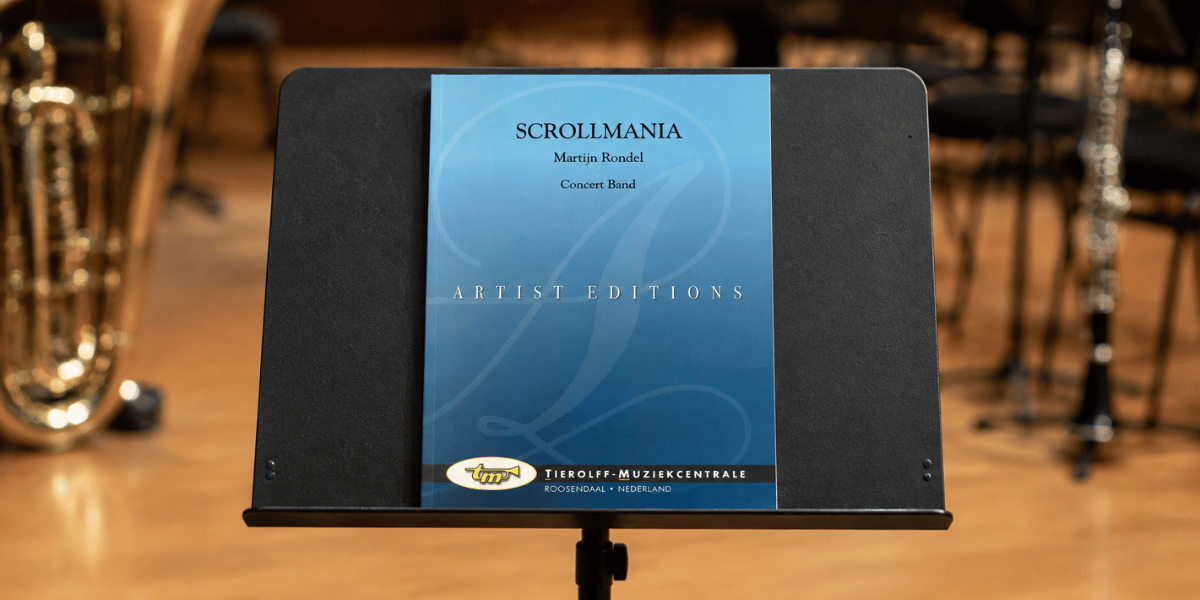
“Scrollmania” – Many an orchestra director will have noticed it: as soon as a break begins or a rehearsal ends, hands are already busy with mobile phones. They scroll until the buttons glow. Now, composer Martijn Rondel has taken up this theme in his composition “Scrollmania“” and deliberately incorporated mobile phones into the piece: a central element is the use of QR codes in the score, which musicians scan with their smartphones to integrate additional sounds. In this way, the smartphone becomes an instrument, symbolizing the intrusion of the digital world into all areas of life. The QR moments illustrate the unstoppable encroachment of digital life and the compulsion for constant online presence. The piece implements this theme both musically and conceptually, encouraging reflection on one’s own relationship with digital media. The work can be performed without the use of mobile phones, making this part optional. The decision rests with the concert band and/or the conductor. This composition also lends its name to the new releases catalog.
A wide range of works is presented, from beginner ensembles to concert bands of the highest artistic level, spanning pop music to classics, light entertainment to solo works, and especially a wealth of music for young bands.
1. Five Pillars, by Fritz Neuböck. This work is a five-part composition for top-tier concert band, inspired by the values of the Timelkam Market Music Band: music, harmony, goals, generations, and fun & joy.
2. A Different Donau by Anton Burger is a humorous Latin interpretation of Johann Strauss’s “The Blue Danube.” Instead of the classic 3/4 time, the work is transposed into a 4/4 Latin groove and enriched with unexpected sonic ideas.
3. An Expression of Joy by Thomas Asanger. This three-movement composition reflects the historical and cultural identity of the town of Oberdrauburg.
4. “Big Top Extravaganza” is a collection of spectacular circus music arranged by Ed Huckeby, uniting classic elements such as clowns, acrobatics, and animal acts.
5. “Bridge Over Troubled Water” by Simon Garfunkel is an award-winning classic that captivates through its emotional depth and gospel-inspired piano accompaniment. Anton Burger’s arrangement for concert band allows for a flexible solo part featuring instruments such as flute, clarinet, trumpet, or vocals.
6. “C’est la vie” is the Dutch entry for the Eurovision Song Contest 2025, performed by Claude Kiambe. Martijn Rondel created an arrangement for concert band in which several musical elements were added to give the work a slightly more symphonic character.
7. Juan A. Pérez’s composition “Calisto y Melibea” for concert band provides a musical setting for the tragic love story of “La Celestina” (1499). The movements—ranging from a tender Andantino and a passionate Allegro con spirito to a dramatic Furioso and a sensual Tempo de Habanera—reflect the emotional evolution of the characters.
8. Daniel Muck’s composition “Ceres (Historia Planetulae)” for concert band translates scientific findings about the dwarf planet into music: through timbres, rhythms, and dynamics, the characteristics of Ceres are made sonically tangible.
9. The idiom “on cloud nine” describes a feeling of absolute bliss. Naoya Wada composed the concert march “Cloud Nine” as a commission for the Japan Ground Self-Defense Force 4th Division Band.
10. The “Concertino for Eb Clarinet and Concert Band” by Bob Vos (1910–1963) is a significant work for E-flat clarinet and advanced concert band, written in 1961. Vos, a student of Henk Badings, combined a modern, experimental tonal language with serial composition techniques.
11. The operetta “Die Drei Wünsche” (The Three Wishes) by Carl Michael Ziehrer (1901) is a quintessential work of the Viennese operetta tradition, featuring catchy melodies and lively orchestration. Fritz Neuböck arranged the overture for upper-level concert band, preserving the original themes while adapting technically demanding passages.
12. Dionysos (Bacchanal) is an original composition for concert band (symphonic band or fanfare orchestra) by one of the most important Belgian composers of the twentieth century, Marcel Poot. Although composed in the 1930s, the piece has now been adapted for modern concert band instrumentation by André Waignein, a former student of Poot.
13. “Don’t Know Much” was written in 1980 by Barry Mann, Cynthia Weil, and Tom Snow, but it only became a global hit through the Grammy-winning interpretation by Linda Ronstadt and Aaron Neville in 1989.
14. The opera “In the Well” (1894) by Vilém Blodek is a lyrical-dramatic work of the late Romantic period that tells a tragic love story. Wil van der Beek arranged the Intermezzo for intermediate concert band, preserving the tonal beauty of the original while simplifying the technical demands.
15. Commissioned by the Highlands Ranch Concert Band (Colorado, USA) and dedicated to the memory of their clarinetist Michelle Marie Walker, Let’s Celebrate Life unites vitality, warmth, and emotion.
16. The medley “Mexican Jamboree” by Johan Nijs combines four of the most famous Mexican songs into a festive arrangement for concert band.
17. The “Mississippi Suite” (1926) by Ferde Grofé is a four-part piece of program music that musically portraits the Mississippi River and its cultural diversity. Wil van der Beek’s arrangement for upper-level concert band makes the work accessible without altering its musical substance.
18. The Cathedral of Notre-Dame de Bayeux, consecrated in 1077, is a significant sacred monument in Normandy that combines Romanesque and Gothic stylistic elements. With his eponymous composition for top-tier concert band, Belgian composer Benoît Chantry has created a musical homage to the cathedral.
19. The composition “Paseo Por La Playa” by Dick le Mair for intermediate concert band captivates with its vibrant, summery atmosphere.
20. The term “Prehistoric” in music refers to the artistic exploration of primeval times, characterized by archaic soundscapes, rhythmic primitivity, and the depiction of man’s connection to nature. Ed Huckeby’s composition of the same name connects these themes with the landscape of the Kansas Flint Hills.
21. The composition “Rialto Ripples” by George Gershwin is among the early works of the famous composer and is also his only ragtime.
22. The title “Rise Up To The Sky” by Florian Moitzi combines traditional fanfare sounds with modern funk elements and Latin American influences.
23. The composition Scrollmania by Martijn Rondel for top-tier concert band addresses the digital age. A central element is the use of QR codes in the score, which musicians scan with their smartphones to integrate additional sounds.
24. The film The Sea Hawk (1940) by Michael Curtiz is a classic adventure movie starring Errol Flynn, which served as pro-British war propaganda. Wil van der Beek arranged the famous fanfare for concert band, with trumpets and trombones taking over the heroic motifs.
25. “Sing Out, and Dance!” by Fritz Neuböck is an entertaining solo piece for euphonium (baritone) and concert band.
26. The symphonic suite “Tales From Spain” by Spanish composer Juan A. Pérez is a four-part composition for intermediate concert band that musically translates the historical and mythical tales of Spain.
27. Naoya Wada’s composition The Land Of Grace is a musical homage to Fukuoka Prefecture and the 4th Division of the Japan Ground Self-Defense Force. In four sections, the work connects the landscape, city life, and the military’s mission of protection.
28. The legend of the Black Ferryman remains a cultural heritage that addresses timeless themes such as greed, morality, and justice. One example is the composition “The Legend Of The Greedy Ferryman” by Sven van Calster. The work combines the dark atmosphere of the legend with modern concert band music.
29. Fritz Neuböck’s composition “You’re Welcome” for the Owen City Band combines the modern, inviting title with the traditional chorale “Geh aus, mein Herz, und suche Freud” by Paul Gerhardt.
Helmut Schwaiger




