

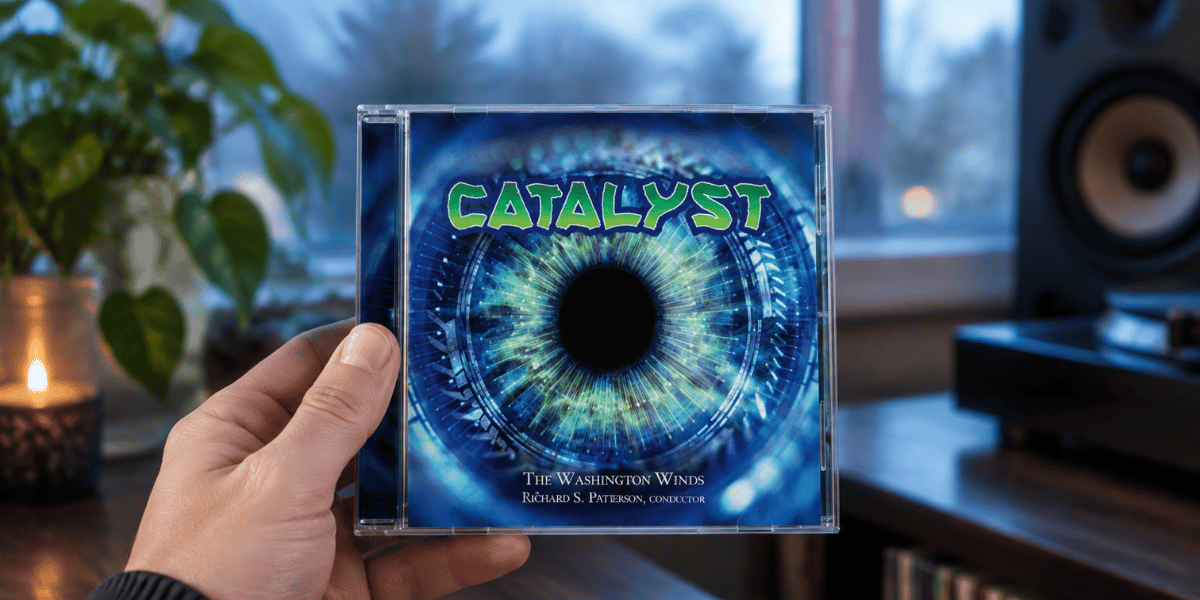
The CD “Catalyst” by the Washington Winds, conducted by Edward Petersen, brings together 20 works for wind orchestra. The program ranges from fanfares and concert pieces to lyrical titles, galops, marches, and works with programmatic titles. This compilation thus offers starting points for various concert programs and for repertoire work with youth and intermediate-level ensembles.
The title track “Catalyst” by Rob Romeyn relies on rhythmic contrasts, changing meters, and melodic development. The publisher’s description mentions an initially striking rhythmic energy, a subsequent expansion of the melodic material, and a contemporary-influenced conclusion. This makes the work a potential focal point of the program, but also demands attention to rhythmic precision and ensemble cohesion.
Other titles promise diverse programmatic effects. “Celebration Fanfare” by Steven Reineke, arranged by Rob Romeyn, is suitable as an opening accent according to its title. However, the publisher assigns the work to the repertoire for advanced ensembles. Therefore, it should not be planned as a Grade 2 piece without reviewing the score. “Petersborough Sleighride Galop” by Albert Eilenberg, arranged by Andrew Glover, offers a contrast to the more concertante character of such opening works. “Catapult!” by David R. Huckeby and “Tornado Alley” by James Susi also indicate a dynamic program profile through their titles alone.
More lyrical and contemplative perspectives are opened by, among others, “To A New Journey” by Naoya Wada, “Among The Stars” by Galvin, “To Those Who Dream” by Daehn, and “The Morning’s First Light” by Shaffer. “A Fond Farewell” by Susi complements the selection with a title that could be suitable for a quieter moment in the concert. “Petite Piece Concertante” by Balay, arranged by Glover, and “From Wales To Harlech” arranged by Glover expand the program with works related to concert tradition and repertoire maintenance. Additionally, there are “Swirling In The Light Bulbs” by Sciaino, “Maelstrom” by Neeck, “To Honor America” by Swearingen, “Dancing In The Rain” by Jarvis, “River Of Peril” by Webb, “Spring’s Awakening” by Bell, “With One Courageous Voice” by Eastmond and “Island Fiesta” by C. T. Smith.
For music educators and conductors, the particular benefit of this compilation lies in its stylistic breadth. The works can introduce different musical focal points into rehearsal work: rhythmic accuracy, articulation, dynamic gradation, melodic shaping, and ensemble playing within the sound body. However, which titles are actually suitable for an ensemble from Grade 2 cannot be derived solely from the title list. Difficulty levels and requirements for range, rhythm, instrumentation, and endurance should be checked against the respective score. The grading can also vary depending on the publisher and evaluation system.
The interpretation by the Washington Winds under Petersen should also be evaluated directly from the recording for a complete review. Without a listening comparison, neither sound balance, articulation, and tempi nor the precision of execution can be reliably assessed. The present classification therefore refers to the selection of works and not to the sonic quality of the recording.
“Catalyst” is thus primarily interesting as a broad repertoire overview. The CD can provide conductors and teachers with inspiration for program design and work research. For the selection of individual pieces in the youth or intermediate level, consulting the score remains crucial.
Helmut Schwaiger (AI)




